🛕About Temple
Veeratteswarar Temple at Vazhuvur, in Mayiladuthurai district of Tamil Nadu, is a revered Shaiva temple dedicated to Lord Shiva. The presiding deity is worshipped as Veeratteswarar and also as Krittivaseswarar, the Lord who wears the elephant skin. Vazhuvur is counted among the Ashta Veerattanam temples, the eight sacred places associated with Shiva’s heroic acts.
The temple’s religious identity is centred on the Gajasamhara episode, in which Shiva subdued the elephant-demon Gajasura and manifested as the fierce yet graceful Gajasamharamurti. This form is especially important in Shaiva iconography, and Vazhuvur is one of the most celebrated places connected with it. The goddess is worshipped as Balakujambal, also known as Ilankilai Nayaki.
Vazhuvur is also honoured in the Tamil Shaiva devotional tradition as a Paadal Petra Sthalam, a temple praised in the Tevaram hymns of the Nayanmars. Located in the Kaveri delta region, the temple remains a living place of worship where devotees visit for darshan of Veeratteswarar, Balakujambal, and the renowned Gajasamhara form of Shiva. Its importance lies in the union of sacred mythology, Tamil bhakti literature, Chola-period temple culture, and the continuing worship traditions of Tamil Shaivism.
ℹ️Temple Information
🛕
Presiding Deity
Veeratteswarar
⭐
Temple Type
Shiva temple, Ashta Veerattanam temple, Paadal Petra Sthalam, Tamil Shaiva temple
📅
Built Period
Documented as an active Shaiva shrine by the 7th century CE through Tevaram hymns; the present masonry temple reflects medieval Chola-period temple culture with later additions.
Need Help Planning your visit to
Arulmigu Veeratteswarar Temple?
Our travel experts can help you with transportation,
darshan timings, nearby sightseeing and complete temple tour planning.
⭐Temple Significance
Vazhuvur Veeratteswarar Temple is significant as one of the Ashta Veerattanam temples, the sacred Shaiva sites associated with Shiva’s heroic acts. It is specifically connected with Gajasamhara, Shiva’s destruction of the elephant-demon Gajasura. The temple is also a Paadal Petra Sthalam praised in the Tevaram hymns, giving it high importance in Tamil Shaiva devotional tradition.
📜History
The sacred status of Veeratteswarar Temple is firmly established through the Tamil Shaiva canon. Vazhuvur is one of the shrines celebrated in the Tevaram, the 7th-century devotional hymns of the Nayanmars. This confirms that the site was an active Shaiva centre by the early medieval period and had already acquired religious importance among the temples of the Kaveri region.
The present temple belongs to the long historical landscape of Chola Nadu, where many brick shrines developed into stone temples under Chola patronage. Vazhuvur’s association with the Ashta Veerattanam group, its Tevaram status, and its location in the fertile Mayiladuthurai region connect it with the broader growth of temple worship, ritual endowments, bronze icons, and Shaiva devotional culture during the medieval Chola period.
The temple is especially known in art-historical discussions for the Gajasamhara form of Shiva, a theme that received distinguished expression in Chola bronze and stone sculpture. While the precise original builder is not securely documented in widely available historical accounts, the shrine’s antiquity is supported by its Tevaram association, and its later architectural and iconographic development reflects the mature Shaiva temple culture of the Chola country. The temple continues to be venerated as both a historical Shaiva shrine and a sacred site of mythological significance.
🕉️Mythology
The central mythology of Vazhuvur concerns Shiva’s destruction of Gajasura, the elephant-demon. In Shaiva sacred narrative, arrogant forces that opposed divine order took the form of a powerful elephant. Shiva confronted the demon, killed it, and wore its hide as a garment. Because of this act, he is worshipped here as Krittivaseswarar, meaning the Lord clothed in the skin, and as Veeratteswarar, the heroic Lord.
The episode is linked with the Gajasamhara form of Shiva. In this form, Shiva is shown in a dynamic dance, holding or wearing the flayed elephant skin, with multiple arms expressing both ferocity and cosmic control. The image conveys the destruction of ego, violence, and ignorance. At Vazhuvur, this fierce manifestation is not treated merely as a destructive act but as a revelation of divine grace that restores balance.
Local Shaiva tradition also associates the scene with the presence of Parvati and the child Skanda, who witness the terrifying splendour of Shiva’s Gajasamhara form. This gives the mythology a deeply emotional dimension: the Lord appears fierce to the forces of arrogance, yet remains the compassionate protector of devotees. Vazhuvur’s place among the Ashta Veerattanam temples comes from this mythic act, and pilgrims visit the shrine to worship Shiva as the one who removes inner darkness and conquers destructive pride.
🏛Architecture
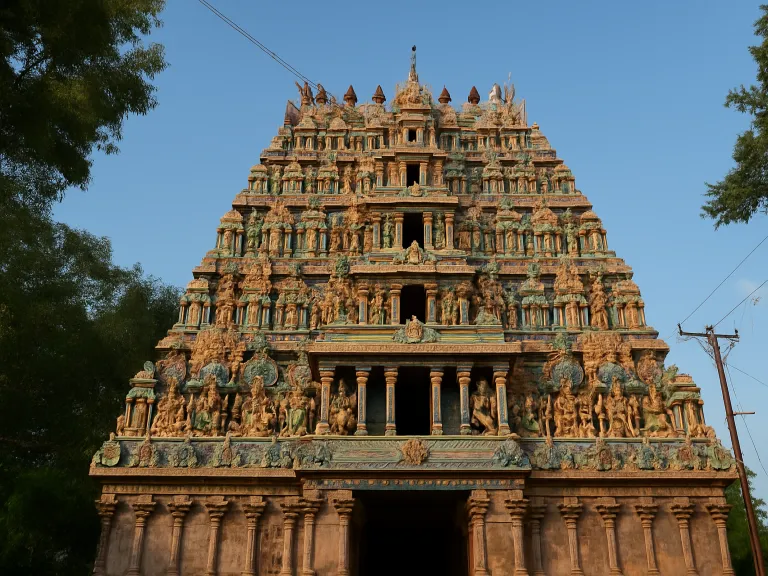
Veeratteswarar Temple follows the architectural language of Tamil Shaiva temples in the Kaveri delta. The complex is organised around the sanctum of Shiva, with associated shrines, circumambulatory spaces, mandapas, and sculptural elements used for ritual movement and festival worship. Its layout reflects the development of temple-centred worship that became prominent in Chola Nadu.
The most distinctive artistic feature of Vazhuvur is its association with Gajasamharamurti. The Gajasamhara iconography presents Shiva in vigorous movement, wearing or spreading the elephant skin, a theme demanding great sculptural skill. Vazhuvur is especially valued for this form because it combines theological meaning with dramatic visual expression: Shiva appears terrifying, graceful, victorious, and compassionate at the same time.
The temple also preserves the standard devotional arrangement of a Shaiva shrine, with separate worship for the goddess Balakujambal and other attendant deities. The presence of the Gajasamhara theme within a functioning temple setting shows how mythology, liturgy, and art interact in South Indian temple culture. While many structural details reflect later maintenance and additions, the temple’s sacred plan, iconographic focus, and Chola-country setting make it an important site for understanding both Tamil Shaiva worship and the artistic vocabulary of heroic Shiva forms.
✨
Temple Highlights
✨
Ashta Veerattanam Shrine
Vazhuvur is one of the eight sacred Shaiva temples associated with the heroic acts of Lord Shiva.
✨
Gajasamhara Sthalam
The temple is linked with Shiva’s destruction of Gajasura and his manifestation as Gajasamharamurti.
✨
Paadal Petra Sthalam
The shrine is honoured in the Tevaram hymns, placing it among the celebrated Tamil Shaiva temples.
✨
Krittivaseswarar Worship
Shiva is worshipped here as the Lord who wears the elephant skin, a direct reference to the Gajasamhara episode.
✨
Balakujambal Shrine
The goddess is worshipped as Balakujambal, also known as Ilankilai Nayaki, in the temple complex.
✨
Chola Country Temple Tradition
The temple belongs to the sacred landscape of Chola Nadu, a region renowned for Shaiva temples, bronze icons, and devotional literature.
🙏
Spiritual Benefits
Devotees pray for removal of ego and arrogance, symbolised by the Gajasamhara episode.
Devotees seek courage to overcome fear, adversity, and inner weakness.
Worship of Veeratteswarar is associated with protection from destructive tendencies.
Devotees pray for spiritual clarity and release from ignorance.
Couples and families offer prayers to Shiva and Balakujambal for harmony and wellbeing.
Pradosham worship is considered especially sacred for devotion to Lord Shiva.
Pilgrims visit the shrine as part of the Ashta Veerattanam circuit for deeper Shaiva worship.
🎉
Major Festivals
🎉
Maha Shivaratri
A major festival for Lord Shiva, observed with special worship and night-long devotion in Shaiva temples.
🎉
Pradosham
The twice-monthly Pradosham period is sacred to Shiva worship and is observed by devotees seeking darshan and offering prayers.
🎉
Thiruvathirai
Thiruvathirai is associated with Shiva’s cosmic dance and is an important observance in Tamil Shaiva temples.
🎉
Aippasi Annabhishekam
Annabhishekam, the offering of cooked rice to the Shiva lingam, is an important annual observance in many Tamil Shiva temples during the month of Aippasi.
🪔
Special Poojas
🪔
Pradosha Pooja
Special worship of Lord Shiva during Pradosham, the sacred twilight period occurring twice each lunar month.
🪔
Abhishekam to Veeratteswarar
Ritual bathing of the Shiva lingam with sacred substances as part of Shaiva temple worship.
🪔
Archana to Balakujambal
Devotees offer name-based worship to the goddess Balakujambal for blessings and protection.
🪔
Maha Shivaratri Pooja
Special worship performed for Lord Shiva on Maha Shivaratri, one of the most important Shaiva observances.
🚗
How to Reach
🛣️
By Road
Vazhuvur is accessible by road from Mayiladuthurai, the nearest major town. Local buses, taxis, and private vehicles connect Mayiladuthurai with surrounding villages including Vazhuvur.
🚆
By Rail
Mayiladuthurai Junction is the nearest major railway station and has rail connections to several towns and cities in Tamil Nadu. From the station, visitors can travel by road to Vazhuvur.
✈️
By Air
The nearest major airport commonly used for this region is Tiruchirappalli International Airport. From there, travellers can continue by road or rail via Mayiladuthurai.
🔗
Related Temples
Amritaghateswarar Temple, Thirukadaiyur
📍 Thirukadaiyur •
One of the Ashta Veerattanam temples, associated with Shiva subduing Yama.
View Details
Veeratteswarar Temple, Thiruvathigai
📍 Thiruvathigai •
One of the Ashta Veerattanam temples, associated with Tripura Samhara.
View Details
Veeratteswarar Temple, Tirukkovilur
📍 Thirukoilur •
One of the Ashta Veerattanam temples, associated with Shiva’s heroic destruction of Andhakasura.
View Details
Veeratteswarar Temple, Thirukkurukkai
📍 Thirukkurukkai •
One of the Ashta Veerattanam temples, associated with the burning of Kama.
View Details
Brahmapureeswarar Temple, Kandiyur
📍 Kandiyur •
One of the Ashta Veerattanam temples, associated with Shiva removing one head of Brahma.
View Details
Veeratteswarar Temple, Tiruvirkudi
📍 Thiruvirkudi •
One of the Ashta Veerattanam temples, associated with the destruction of Jalandhara.
View Details
💡
Visitor Tips
Confirm current opening hours locally before travelling, as published timings can change on festival and special pooja days.
Mayiladuthurai is the most convenient nearby town for transport connections and basic facilities.
Maintain silence and decorum inside the temple, especially near the sanctum and during pooja.
Seek permission before photographing any part of the temple, particularly shrines and icons.
Plan extra time if visiting on Pradosham, Maha Shivaratri, or other crowded worship days.
Wear modest clothing suitable for a traditional South Indian temple visit.
Combine the visit with other nearby Mayiladuthurai temples if travelling on a pilgrimage itinerary.

 WhatsApp Us