About Temple
Airavatesvara Temple is a celebrated Shiva temple at Darasuram, near Kumbakonam in Thanjavur district of Tamil Nadu. The presiding deity is Airavatesvara, a form of Shiva worshipped in the linga form. The temple is one of the most important surviving monuments of the later Chola period and is renowned for the refinement of its sculpture, compact planning, and devotional continuity.
The temple forms part of the UNESCO World Heritage property known as the Great Living Chola Temples, along with Brihadisvara Temple at Thanjavur and Brihadisvara Temple at Gangaikonda Cholapuram. Although smaller than the imperial Chola temples at Thanjavur and Gangaikonda Cholapuram, Airavatesvara Temple is especially admired for the density and delicacy of its carvings. Its sculptural program includes deities, dancers, musicians, guardians, mythological scenes, and miniature panels.
Located a few kilometres from Kumbakonam, the temple is accessible to pilgrims, art historians, and heritage travellers exploring the Kaveri delta. Darasuram was historically known as Rajarajapuram, reflecting its association with the Chola ruler Rajaraja II. The temple remains a place of worship while also being protected as a heritage monument. Its importance lies in the way it brings together Chola political memory, Saiva devotion, stone architecture, bronze-age artistic sensibility, and local temple tradition in a single sacred complex.
Temple Significance
Airavatesvara Temple is significant as a 12th-century Chola Shiva temple, a UNESCO World Heritage monument, and one of the Great Living Chola Temples. It preserves the artistic excellence of the later Chola period and remains an active place of worship dedicated to Shiva as Airavatesvara.
History
Airavatesvara Temple was built in the 12th century CE by the Chola king Rajaraja II, who ruled in the middle phase of the later Chola period. The site was then known as Rajarajapuram, a name connected with the king. The temple reflects the continued wealth, ritual culture, and artistic ambition of the Chola state after the age of Rajaraja I and Rajendra I.
Inscriptions associated with the temple and its region indicate the Chola practice of endowing temples with land, lamps, offerings, and arrangements for worship. Like other major Chola temples, Airavatesvara was not only a sacred centre but also an institution connected with administration, artisans, music, ritual specialists, and the agrarian economy of the Kaveri delta. Its scale is more compact than the earlier imperial temples, but its sculptural sophistication marks a high point of later Chola craftsmanship.
The temple survived through subsequent political changes in Tamil Nadu, including the periods after Chola power declined. Parts of the original enclosure and gateway structures suffered damage over time, but the main shrine, mandapas, and many sculptures remain. In 2004, Airavatesvara Temple was added to the UNESCO World Heritage listing as part of the Great Living Chola Temples. Today it is recognized both as a living Shiva temple and as a protected monument representing the architectural legacy of the Chola dynasty.
Mythology
The temple’s name is connected with Airavata, the white elephant of Indra in Hindu mythology. Temple tradition narrates that Airavata worshipped Shiva at this sacred place and was relieved of a curse or affliction. Because Shiva granted grace to Airavata here, the deity came to be known as Airavatesvara, meaning the Lord worshipped by Airavata.
Another well-known local sacred narrative associates the temple with Yama, the god of death. In this account, Yama suffered from a curse and came to this place to worship Shiva. He bathed in the sacred water associated with the temple and received relief through Shiva’s grace. This narrative explains the sanctity attached to the temple’s theertham in local tradition and adds another layer to the temple’s identity as a place of healing and release.
These mythological accounts are distinct from the historical record of the temple’s construction under Rajaraja II. They express the religious meaning of the shrine for devotees: Shiva is approached here as a compassionate deity who removes suffering, restores purity, and grants protection. The Airavata legend gives the temple its name, while the Yama legend links the site with deliverance from fear, disease, and karmic burden. Together, these stories sustain the devotional atmosphere of Airavatesvara Temple beyond its importance as a Chola monument.
Architecture
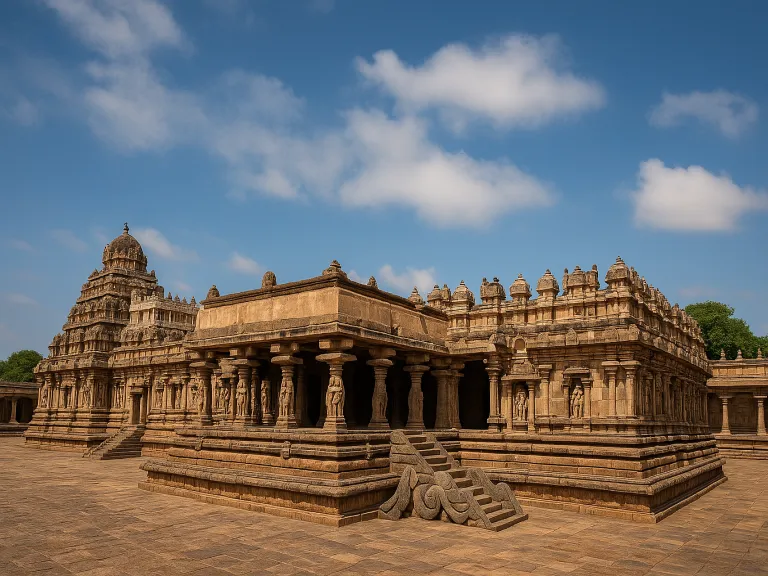
Airavatesvara Temple is an outstanding example of later Chola Dravidian architecture. The complex is built mainly of stone and is organized around the sanctum of Airavatesvara. The vimana over the sanctum is proportionate and richly detailed, showing the Chola preference for disciplined geometry combined with sculptural abundance. The temple’s architectural character is more compact than the great temples at Thanjavur and Gangaikonda Cholapuram, but its ornamentation is exceptionally intricate.
One of the most famous features is the mandapa designed with the visual effect of a stone chariot, complete with carved wheels and horses. The temple is also known for its musical steps, which are associated with different tonal sounds when gently struck. The walls, pillars, bases, and niches contain finely carved images of deities, ganas, dancers, musicians, warriors, animals, and narrative scenes. Many carvings are small in scale but remarkable in detail.
The sculptural program reflects the mature artistic language of the Chola period. Shaiva themes dominate, but the decorative scheme also includes broader religious and cultural imagery. The goddess shrine is separate from the main sanctum, a feature seen in several South Indian temple complexes. Even where parts of the outer structures have been altered or damaged over time, the surviving core demonstrates the technical mastery of Chola architects and sculptors. Airavatesvara Temple is valued for precision, rhythm, narrative richness, and the harmonious integration of architecture and sculpture.
Sacred Features
Temple Tank
Yama Theertham
Temple tradition connects this sacred water source with the story of Yama worshipping Shiva and receiving relief from affliction.
Temple Highlights
UNESCO World Heritage Monument
Airavatesvara Temple is part of the Great Living Chola Temples World Heritage property, along with the Chola temples at Thanjavur and Gangaikonda Cholapuram.
Built by Rajaraja II
The temple was constructed in the 12th century CE under the Chola king Rajaraja II at the historic settlement of Rajarajapuram, now Darasuram.
Chariot-like Mandapa
The front mandapa is celebrated for its sculpted stone chariot effect, including carved wheels and horses.
Fine Later Chola Sculpture
The temple is known for dense and refined carvings of deities, dancers, musicians, animals, guardians, and narrative panels.
Airavata Legend
The name Airavatesvara comes from the temple tradition that Airavata, Indra’s white elephant, worshipped Shiva here.
Living Shiva Temple
The monument remains a sacred shrine where Shiva is worshipped in linga form.
Spiritual Benefits
- Devotees pray for relief from suffering and afflictions through the grace of Shiva as Airavatesvara.
- The Airavata legend makes the temple associated with purification and restoration.
- The Yama-related temple tradition connects the shrine with freedom from fear and karmic burden.
- Worshippers seek blessings for health, protection, and mental peace.
- The temple is regarded as a sacred place for Shiva worship in the Kaveri delta.
- Pilgrims value the shrine for devotion, humility, and surrender to Shiva.
- The sacred atmosphere of the temple supports meditation on Chola Saiva heritage and divine grace.
Major Festivals
Maha Shivaratri
A major festival dedicated to Shiva, observed with special devotion at Shiva temples including Airavatesvara Temple.
Pradosham
A recurring Shaiva observance associated with worship of Shiva, especially in the evening period of the lunar fortnight.
Aippasi Annabhishekam
A Shaiva ritual observance in the Tamil month of Aippasi in which the Shiva linga is worshipped with cooked rice offerings in many Shiva temples.
Special Poojas
Abhishekam
Ritual bathing of the Shiva linga with sacred substances as part of Shiva worship.
Archana
Offering of prayers and names of the deity by the priest on behalf of devotees.
Pradosha Pooja
Special worship of Shiva performed during Pradosham, a significant time in the Shaiva calendar.
Maha Shivaratri Worship
Special worship associated with the annual night-long festival dedicated to Shiva.
How to Reach
By Road
Darasuram is near Kumbakonam and can be reached by local road transport, taxis, and buses from Kumbakonam and nearby towns in the Kaveri delta.
By Rail
Darasuram has a railway station nearby, and Kumbakonam Railway Station is a major convenient railhead for visitors.
By Air
The nearest major airport is Tiruchirappalli International Airport, from where Darasuram can be reached by road via the Kumbakonam region.
Nearby Temples
Patteswaram Thenupuriswarar Temple
about 3 km
A historic Shiva temple near Darasuram, associated with Saiva worship and local temple traditions.
Adi Kumbeswarar Temple, Kumbakonam
about 5 km
A major Shiva temple in Kumbakonam and one of the most important temples of the town.
Sarangapani Temple, Kumbakonam
about 5 km
A prominent Vishnu temple in Kumbakonam and one of the Divya Desams.
Chakrapani Temple, Kumbakonam
about 5 km
A well-known Vishnu temple in Kumbakonam dedicated to Chakrapani.
Swamimalai Swaminathaswamy Temple
about 8 km
One of the six sacred abodes of Murugan, located near Kumbakonam.
Related Temples
Brihadisvara Temple, Thanjavur
Part of the Great Living Chola Temples UNESCO World Heritage property.
Brihadisvara Temple, Gangaikonda Cholapuram
Part of the Great Living Chola Temples UNESCO World Heritage property.
Visitor Tips
-
Verify current worship timings locally before planning darshan, as schedules can change.
-
Visit early in the morning or late afternoon for comfortable weather and better visibility of carvings.
-
Wear modest clothing appropriate for a Hindu temple.
-
Do not touch or climb on sculptures, carved wheels, steps, or protected stone surfaces.
-
Allow enough time to study the miniature carvings around the mandapas and shrine walls.
-
Kumbakonam is a convenient base for visiting Darasuram and other nearby temples.
-
Carry drinking water during hot months, especially between March and June.
-
Respect areas marked for worship and any instructions given by temple staff or monument authorities.

 WhatsApp Us