About Temple
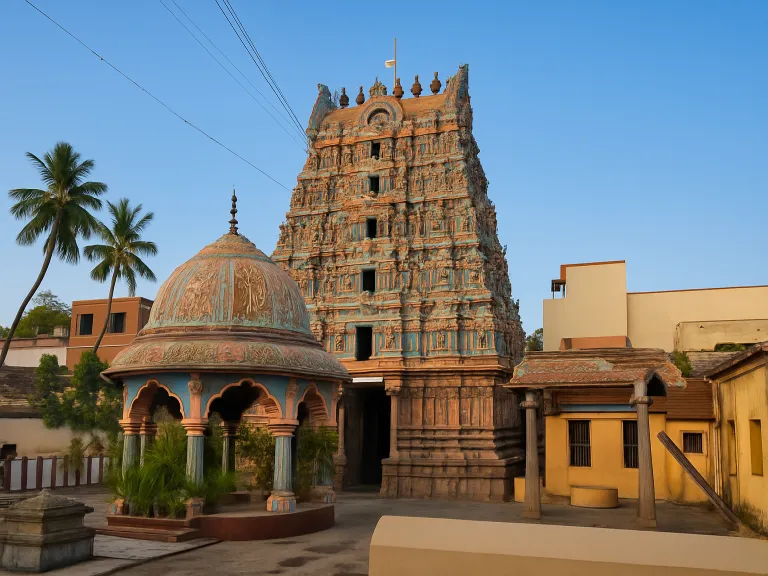
Chakrapani Swami Temple is an important Vishnu temple in Kumbakonam, Tamil Nadu, dedicated to Lord Chakrapani, a form of Vishnu associated with the Sudarshana Chakra. The temple stands within the sacred temple town of Kumbakonam, close to the Cauvery river system and the cluster of ancient Saiva and Vaishnava shrines that define the religious geography of the town. The name Chakrapani means the Lord who bears the discus.
The presiding deity is worshipped as Chakrapani Swami, with Vijayavalli Thayar as the consort. The temple is especially known for its iconography of Vishnu connected with the divine discus and for its local association with Surya, the Sun. Unlike many Vishnu images that emphasize the four-armed form, Chakrapani is represented in a distinctive martial and radiant aspect, emphasizing protection, order, and the power of dharma.
The temple is one of the prominent Vaishnavite shrines of Kumbakonam, though it is not counted among the 108 Divya Desams. It is visited along with Sarangapani Temple, Ramaswamy Temple, and other major temples in the town. Its historical layers, ritual importance, and position in Kumbakonam’s sacred landscape make it a significant pilgrimage site for devotees of Vishnu and for visitors studying the religious history of the Chola region.
Temple Information
| Presiding Deity |
Chakrapani Swami |
| Goddess |
Vijayavalli Thayar |
| Temple Type |
Vishnu temple, Vaishnavite temple, Dravidian temple |
| District |
Thanjavur
|
| Built Period |
Medieval period, with a Chola-period core and later additions under subsequent regional powers |
| Dynasty |
Chola; later Vijayanagara-Nayak and Thanjavur Maratha patronage |
| Sampradaya |
|
Temple Significance
Chakrapani Swami Temple is significant as a major Vishnu shrine of Kumbakonam dedicated to Vishnu in the aspect of the divine discus. It is noted for its distinctive iconography, its association with Surya in local tradition, and its place within the sacred temple network of Kumbakonam.
History
The early foundation history of Chakrapani Swami Temple is not preserved in a single widely accepted foundation record naming an individual builder. The temple belongs to the medieval sacred landscape of Kumbakonam, a town that received extensive religious patronage under the Cholas and later under the Vijayanagara-Nayak and Thanjavur Maratha rulers. Its stone architecture and temple layout reflect the long process of building, renovation, and ritual endowment common to major temples in the Kaveri delta.
Kumbakonam was an important urban and religious centre during the Chola period, and several temples in the town preserve evidence of royal, mercantile, and local patronage. Chakrapani Swami Temple is historically associated with this environment of temple-building and ritual expansion. Later periods added mandapas, gateways, processional arrangements, and festival practices, allowing the shrine to remain active within the town’s Vaishnavite worship network.
The temple’s prominence continued through the Nayak and Maratha periods, when Kumbakonam retained its role as a centre of Sanskritic and Tamil religious culture. The shrine is part of the living temple tradition of the town rather than a monument belonging to only one period. Its historical identity is therefore best understood as a medieval core with later additions, patronage, and renewals, rather than as the work of one recorded founder.
Mythology
The mythology of Chakrapani Swami Temple centres on the Sudarshana Chakra, the divine discus of Vishnu. Local temple tradition narrates that the chakra manifested with extraordinary radiance and power at Kumbakonam. The deity came to be worshipped as Chakrapani, the Lord of the discus, representing Vishnu’s protective and corrective force. In this form, the Lord is invoked as the destroyer of adharma and as the guardian of cosmic order.
A well-known local legend connects the temple with Surya, the Sun god. According to this tradition, Surya became proud of his brilliance, and the radiance of the Sudarshana Chakra surpassed and subdued him. Surya then worshipped Chakrapani and received grace. Because of this legend, the temple is associated with Surya worship in local devotion, although it is not one of the canonical Navagraha temples of Tamil Nadu.
The form of the deity also carries mythic meaning. Chakrapani is worshipped as Vishnu in a fiery and majestic aspect, identified with the energy of the chakra rather than only as a royal or reclining Vishnu. Devotees approach the shrine for protection, clarity, and relief from obstacles, seeing the discus as the power that cuts through negativity and restores balance. These narratives belong to the temple’s sacred tradition and are distinct from the historical record of its construction.
Architecture
Chakrapani Swami Temple follows the Dravidian temple idiom of the Kaveri delta, with a structured arrangement of gateway, courtyards, mandapas, subsidiary shrines, and sanctum. The temple is known for its prominent rajagopuram and for the elevated placement of the sanctum, which is reached by steps. The raised sanctum contributes to the visual emphasis on the presiding deity and gives the shrine a distinct presence among Kumbakonam’s Vaishnavite temples.
A notable architectural and ritual feature is the presence of two entrances associated with the solar course, commonly identified with Uttarayana and Dakshinayana. This feature is connected with the temple’s local association with Surya and the symbolism of time, light, and cosmic movement. The temple also contains a separate shrine for Vijayavalli Thayar, in keeping with the pattern of major Vishnu temples in Tamil Nadu.
The iconography of the main deity is central to the temple’s architectural experience. Chakrapani Swami is represented in a powerful form associated with the Sudarshana Chakra, and the image is noted for features that distinguish it from standard standing Vishnu icons. The mandapas and processional spaces support the temple’s continuing ritual life. As with many active temples in Kumbakonam, the present structure reflects multiple phases of construction and renovation rather than a single architectural campaign.
Temple Highlights
Distinctive Chakrapani Form
The presiding deity represents Vishnu in the powerful aspect associated with the Sudarshana Chakra, emphasizing protection and divine radiance.
Surya Association
Local mythology connects the temple with Surya, who is described as receiving grace after his brilliance was subdued by the chakra.
Uttarayana and Dakshinayana Entrances
The temple is noted for entrances associated with the two halves of the solar year, reflecting its symbolic connection with time and the Sun.
Important Kumbakonam Vishnu Shrine
The temple is one of the prominent Vaishnavite shrines in Kumbakonam and is often visited along with other historic temples in the town.
Medieval Dravidian Temple Setting
The temple preserves the layout, ritual spaces, and architectural character of the medieval Kaveri delta temple tradition.
Spiritual Benefits
- Devotees seek protection through the grace of Chakrapani Swami.
- Worship is associated with removal of obstacles and negative influences.
- Devotees pray for clarity, courage, and righteous action.
- The Sudarshana aspect is invoked for spiritual purification.
- Devotees seek relief from fear and inner confusion.
- Worship at the shrine is associated with divine order and protection of dharma.
- The temple’s Surya-related tradition draws devotees seeking vitality and illumination.
Major Festivals
Vaikunta Ekadashi
An important Vishnu festival observed in Vaishnavite temples, drawing devotees for special worship and darshan.
Mahamaham and Masi Magam observances
Kumbakonam’s major sacred bathing and festival traditions involve the town’s important temples, including its prominent Vishnu shrines.
Brahmotsavam
The annual temple festival is associated with processional worship of the deity and special rituals.
How to Reach
By Road
Kumbakonam is well connected by road with Thanjavur, Mayiladuthurai, Chidambaram, and Tiruchirappalli. Local buses, taxis, and auto-rickshaws are available within the town.
By Rail
Kumbakonam Railway Station is the nearest major railhead and is connected to important towns in Tamil Nadu.
By Air
The nearest major airport is Tiruchirappalli International Airport, from where Kumbakonam can be reached by road or rail.
Nearby Temples
Sarangapani Temple
about 1 km
A major Vishnu temple of Kumbakonam and one of the 108 Divya Desams.
Adi Kumbeswarar Temple
about 1 km
A historic Shiva temple central to the sacred identity of Kumbakonam.
Ramaswamy Temple
about 1 km
A prominent temple dedicated to Rama, known for its Vaishnavite worship and historic murals.
Nageswaran Temple
about 1 km
An ancient Shiva temple in Kumbakonam noted for Chola-period architecture.
Kasi Viswanathar Temple, Kumbakonam
about 2 km
A well-known Shiva temple near the Mahamaham tank.
Related Temples
Sarangapani Temple, Kumbakonam
Major Vishnu temple in Kumbakonam and part of the town’s Vaishnavite sacred landscape
Ramaswamy Temple, Kumbakonam
Prominent Vaishnavite temple in Kumbakonam visited along with Chakrapani Swami Temple
Varaha Perumal Temple, Kumbakonam
Nearby Vishnu temple within Kumbakonam’s temple network
Visitor Tips
-
Verify current opening hours with the temple or local sources before visiting.
-
Dress modestly, as this is an active place of worship.
-
Allow time to visit nearby Kumbakonam temples on foot or by local transport.
-
Festival days can be crowded, so plan darshan time accordingly.
-
Follow temple instructions regarding queues, offerings, and photography.
-
Remove footwear before entering the temple premises as required.
-
Carry drinking water during summer months, as Kumbakonam can be hot and humid.

 WhatsApp Us