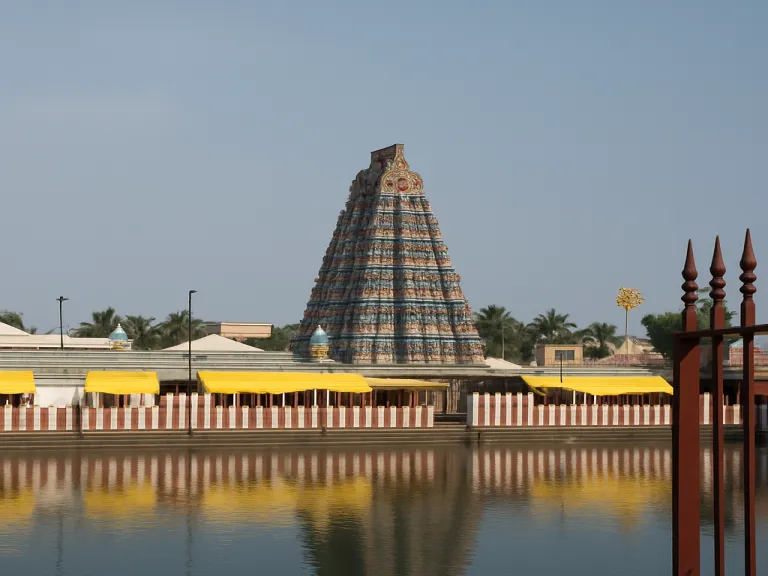
Arulmigu Kandaswamy Temple

Thiruporur, Chengalpattu, Tamil Nadu

Arulmigu Kandaswamy Temple

About Temple

Kandaswamy Temple at Thiruporur is a major Murugan shrine in Chengalpattu district of Tamil Nadu, situated on the Old Mahabalipuram Road between Chennai and Mamallapuram. The presiding deity is Sri Kandaswamy, a form of Murugan or Subramanya, worshipped with his consorts Valli and Deivanai. The place-name Thiruporur is connected with the Tamil word por, meaning war, and the sacred site is also known in devotional usage as Samarapuri or Yuddhapuri.

The temple is especially important for Murugan devotees of northern Tamil Nadu and the Chennai region. Its sacred status is strengthened by its association with Arunagirinathar, the 15th-century saint-poet whose Tiruppugazh hymns praise Murugan at many celebrated shrines, including Thiruporur. The present temple is closely connected with the 17th-century saint Chidambara Swamigal, who is credited with reviving and rebuilding the shrine and organizing its worship.

The temple functions as a living place of worship with regular pujas, festival processions, abhishekams, and devotional offerings centered on Murugan. Devotees visit for prayer, vows, family worship, and festival observances such as Kanda Sashti, Thai Poosam, Vaikasi Visakam, Panguni Uthiram, and Krittikai. The temple’s location makes it accessible from Chennai, the IT corridor, Kelambakkam, Chengalpattu, and the Mamallapuram coast, while retaining the atmosphere of an old Tamil Murugan sthalam.

Temple Information

Presiding Deity Sri Kandaswamy
Goddess Valli and Deivanai
Temple Type Murugan temple, Shaiva temple, Dravidian temple, Pilgrimage temple
District Chengalpattu
Built Period 17th century CE for the present restored temple; the sacred site is older and is attested in 15th-century Tiruppugazh hymns.
Dynasty
Sampradaya

Temple Significance

Kandaswamy Temple, Thiruporur is significant as a historic Murugan shrine near Chennai, praised in Tiruppugazh and revived in the 17th century by Chidambara Swamigal. Its sacred identity is tied to Murugan as the divine warrior of Samarapuri, the place of battle, where devotees seek courage, protection, clarity, and victory over obstacles.

History

The sacred history of Thiruporur is older than the present temple structure. Its antiquity is supported by the devotional record of Arunagirinathar, the 15th-century Tamil saint whose Tiruppugazh hymns include praise of Murugan at Thiruporur. This establishes the site as a recognized Murugan shrine before the 17th century, even though the early founder, original construction date, and ruling dynasty of the earliest temple are not securely documented in widely accepted historical records.

The present Kandaswamy Temple is strongly associated with Chidambara Swamigal, a 17th-century saint and devotee of Murugan. Temple tradition and historical accounts of the shrine credit him with rediscovering or reviving the neglected sacred site, rebuilding the temple, and establishing organized worship. His role is central to the temple’s later history, and the shrine’s identity today is inseparable from his devotional work and institutional restoration.

Later growth of the temple came through local patronage, continued worship, festival endowments, and the sustained devotion of the surrounding region. The temple became one of the best-known Murugan shrines near Chennai and Chengalpattu, drawing pilgrims from both urban and rural communities. While some accounts connect the site with older dynastic periods, the securely documented historical layer most consistently emphasized is the 17th-century revival under Chidambara Swamigal. The temple is now administered as a public Hindu temple in Tamil Nadu and continues to preserve its Murugan-centered ritual and festival traditions.

Mythology

The mythology of Thiruporur centers on Murugan as the divine warrior. The name Thiruporur is understood in the temple’s sacred tradition as the holy place of battle, and the shrine is also referred to as Samarapuri or Yuddhapuri, both meaning a place connected with war. In this mythic setting, Murugan is worshipped as Kandaswamy, the youthful commander of the divine forces who destroys demonic arrogance and restores cosmic order.

Local sthala traditions describe Thiruporur as one of the places where Murugan’s victory over asuric forces is remembered. The mythology does not present the battle merely as physical warfare; it also symbolizes the destruction of ego, ignorance, fear, and hostile tendencies within the devotee. Murugan’s vel, his divine spear, represents wisdom and decisive grace. Worship at Thiruporur is therefore linked with courage, clarity, protection, and victory over obstacles.

A later devotional tradition connects the temple’s revival with Chidambara Swamigal. The tradition narrates that Murugan guided the saint to restore the forgotten shrine and re-establish worship. Such narratives belong to the temple’s sacred memory and are cherished by devotees as signs of Murugan’s continuing presence at Thiruporur. The hymns of Arunagirinathar further enrich the mythology by presenting Murugan of Thiruporur as the compassionate lord who grants grace to those who approach him with devotion, humility, and disciplined worship.

Architecture

Kandaswamy Temple, Thiruporur follows the broad Dravidian temple pattern seen in Tamil Murugan shrines. The complex is organized around a sanctum for Sri Kandaswamy, with spaces for his consorts Valli and Deivanai, processional worship, circumambulation, and festival movement. The entrance, gopuram, mandapas, prakara passages, and subsidiary shrines create the layout of a functioning South Indian temple rather than a purely monumental structure.

The temple’s architectural identity reflects its 17th-century revival and later additions more clearly than an early dynastic phase. The masonry halls and shrine arrangement support daily ritual activity, abhishekam, alankaram, archana, and utsava processions. The presence of mandapas is important for devotees waiting for darshan, for recitation, and for festival preparation. The temple tank, known as Saravana Poigai, forms an important sacred element of the temple environment and is connected with the Murugan tradition of Saravana.

The visual focus of the temple is the presiding Murugan as Kandaswamy with Valli and Deivanai. The iconographic scheme emphasizes Murugan as a victorious, protective, and gracious deity. Like many Tamil temples, the architecture integrates worship, movement, music, lamps, offerings, and seasonal festivals into a single sacred experience. The temple is not known primarily for imperial-scale sculpture or inscriptional grandeur; its architectural significance lies in the continuity of a historic Murugan shrine restored by Chidambara Swamigal and sustained by living devotional practice.

Sacred Features

Temple Tree

Temple Tank
Saravana Poigai

The temple tank is associated with the Murugan tradition and forms an important sacred feature of the Thiruporur temple complex.

Temple Highlights

Historic Murugan shrine near Chennai

Thiruporur Kandaswamy Temple is one of the best-known Murugan temples in the Chennai and Chengalpattu region.

Praised in Tiruppugazh

The shrine is associated with Arunagirinathar’s Tiruppugazh tradition, confirming its importance before the 17th-century restoration.

Revived by Chidambara Swamigal

The present temple is closely linked with the 17th-century saint Chidambara Swamigal, who is credited with restoring the shrine and worship.

Samarapuri tradition

The temple’s sacred name and mythology connect it with Murugan as the divine warrior who grants victory over hostile forces and inner obstacles.

Saravana Poigai

The temple tank, Saravana Poigai, is an important sacred feature associated with the Murugan tradition.

Accessible pilgrimage location

The temple is located on the Old Mahabalipuram Road, making it accessible from Chennai, Kelambakkam, Chengalpattu, and Mamallapuram.

Spiritual Benefits

  • Devotees pray for courage and confidence.
  • Devotees seek protection from fear and adversity.
  • Devotees pray for removal of obstacles.
  • Devotees seek success in righteous efforts and undertakings.
  • Devotees worship for clarity, discipline, and wisdom symbolized by Murugan’s vel.
  • Devotees pray for harmony in family life.
  • Devotees offer vows during Sashti, Krittikai, and major Murugan festivals.
  • Devotees seek Murugan’s grace for inner strength and spiritual progress.

Major Festivals

Kanda Sashti

A major Murugan festival commemorating Murugan’s victory over asuric forces. Devotees observe fasting, special worship, and prayers for victory over obstacles.

Thai Poosam

An important festival for Murugan devotees, observed in the Tamil month of Thai with special worship and devotional offerings.

Vaikasi Visakam

A major Murugan festival associated with the birth star Visakam in the Tamil month of Vaikasi. Devotees perform special prayers and offerings.

Panguni Uthiram

A significant Tamil festival connected with divine marriage traditions, observed for Murugan with Valli and Deivanai.

Krittikai

Krittikai is sacred to Murugan and is observed regularly by devotees with special prayers and offerings.

Special Poojas

Abhishekam

Ritual bathing and worship offered to Murugan according to temple practice, especially on important Murugan observances.

Archana

Name-recitation worship performed for Sri Kandaswamy with offerings by devotees.

Sashti Pooja

Special worship connected with Sashti, a day sacred to Murugan and associated with protection and victory over obstacles.

Krittikai Pooja

Worship performed on Krittikai, a star day closely connected with Murugan devotion.

Festival Alankaram and Utsava Worship

Special decoration and processional worship are performed during major festivals such as Kanda Sashti, Thai Poosam, Vaikasi Visakam, and Panguni Uthiram.

How to Reach

By Road

Thiruporur is on the Old Mahabalipuram Road and is accessible by buses, taxis, and private vehicles from Chennai, Kelambakkam, Chengalpattu, and Mamallapuram.

By Rail

The nearest major railway access is through Chengalpattu Junction and other suburban rail points connected to Chennai, followed by road travel to Thiruporur.

By Air

The nearest airport is Chennai International Airport, from where Thiruporur can be reached by road via Chennai’s southern corridor and Old Mahabalipuram Road.

Nearby Temples

Nithya Kalyana Perumal Temple, Thiruvidanthai
Approximately 14 km

A well-known Divya Desam dedicated to Vishnu, located on the East Coast Road near Thiruvidanthai.

Shore Temple, Mamallapuram
Approximately 16 km

A UNESCO World Heritage monument and historic Pallava-period temple complex on the Mamallapuram coast.

Sthalasayana Perumal Temple, Mamallapuram
Approximately 17 km

A Divya Desam dedicated to Vishnu, located in the historic temple town of Mamallapuram.

Vedagiriswarar Temple, Tirukalukundram
Approximately 23 km

An ancient hill temple dedicated to Shiva, historically important in the Chengalpattu region.

Marundeeswarar Temple, Thiruvanmiyur
Approximately 30 km

A prominent Shiva temple in Chennai associated with healing traditions and the coastal Shaiva pilgrimage route.

Related Temples

Tiruchendur Subramanya Swamy Temple

Major Murugan temple associated with the mythology of Murugan’s victory over Surapadman.

Tiruttani Subramanya Swamy Temple

One of the six celebrated abodes of Murugan in Tamil Nadu.

Palani Dhandayuthapani Swamy Temple

One of the six celebrated abodes of Murugan and a major Murugan pilgrimage center.

Swamimalai Swaminathaswamy Temple

One of the six celebrated abodes of Murugan, associated with Murugan teaching the meaning of Pranava.

Vadapalani Andavar Temple

Prominent Murugan temple in Chennai, visited by devotees from the same regional devotional circuit.

Visitor Tips

  • Verify current opening hours with the temple before travel, especially on festival days.
  • Visit early in the morning or on non-festival weekdays if you prefer a quieter darshan.
  • Expect larger crowds during Kanda Sashti, Thai Poosam, Vaikasi Visakam, Panguni Uthiram, and Krittikai.
  • Wear modest clothing suitable for a Hindu temple.
  • Leave footwear only at the designated place outside the worship area.
  • Follow temple staff instructions regarding queues, offerings, and photography.
  • Carry drinking water during hot months, as Thiruporur can be humid and warm.
  • Use the Old Mahabalipuram Road route if travelling from Chennai or Kelambakkam.
Arulmigu Kandaswamy Temple

Visit Information

Morning
Evening
Best Time November to February offers more comfortable weather. Devotees also visit during Kanda Sashti, Thai Poosam, Vaikasi Visakam, Panguni Uthiram, and Krittikai observances.
Railway Chengalpattu Junction
Approximately 28 km
Airport Chennai International Airport
Approximately 38 km
Location 📍 View on Google Maps

Need Help Planning?

Our travel experts can help you with transportation, darshan timings, nearby sightseeing and complete temple tour planning.

PLAN YOUR TEMPLE VISIT

Planning a visit to Arulmigu Kandaswamy Temple?

Our travel experts can help you plan your temple visit with transportation, nearby sightseeing, accommodation, darshan timings and customized tour packages.

Disclaimer

We strive to provide accurate and authentic information based on well-established historical, cultural, religious, and publicly available sources. However, temple timings, entry fees, rituals, festivals, special poojas, facilities, and other visitor information may change without prior notice.

While every effort is made to keep this information current and accurate, visitors are advised to verify the latest details directly with the official temple authorities before planning their visit.

Image Disclaimer: The images displayed on this website are digitally generated or AI-enhanced representations created for illustrative purposes. They are intended to reflect the appearance and atmosphere of the destination but may not exactly represent the current real-world condition, colours, surroundings, or architectural details of the temple or location.