About Temple
Punnainallur Mariamman Temple, also known as Punnai Nallur Mariamman Kovil, is a prominent Shakti temple at Punnainallur near Thanjavur in Tamil Nadu. The presiding goddess is Sri Muthu Mariamman, worshipped as a powerful form of Amman associated with protection, healing, and motherly grace. The shrine is one of the best-known Mariamman temples in the Thanjavur region and receives large numbers of devotees from the Cauvery delta and other parts of Tamil Nadu.
The temple is closely connected with the Thanjavur Maratha rulers. Its origin is associated with Venkoji, also called Ekoji I, the Maratha ruler of Thanjavur, and the temple’s growth was supported by later Maratha royal patronage. Unlike many stone icons, the main image of the goddess is associated with an anthill form, a feature that gives the shrine a distinctive identity among Amman temples. The sanctum is treated with special care, and regular ablution is performed to the processional image rather than to the main earthen form.
Punnainallur Mariamman is especially revered by devotees seeking relief from illness, eye ailments, skin afflictions, fear, family difficulties, and obstacles. The temple is part of the living religious landscape of Thanjavur, where great Chola, Nayak, and Maratha religious sites stand close to one another. Its importance rests not on imperial scale alone, but on continuous worship, strong local devotion, and the enduring reputation of the goddess as a compassionate guardian of her devotees.
Temple Significance
Punnainallur Mariamman Temple is significant as one of the most revered Mariamman shrines in the Thanjavur region. It is historically associated with the Thanjavur Maratha rulers and devotionally associated with healing, protection, and the motherly grace of Sri Muthu Mariamman. The anthill-related form of the presiding goddess and the temple’s connection with royal healing traditions give it a distinct place among Tamil Nadu’s Amman temples.
History
The historical identity of Punnainallur Mariamman Temple is strongly linked with the Thanjavur Maratha period. Venkoji, or Ekoji I, who established Maratha rule in Thanjavur in the seventeenth century, is associated with the foundation of the temple in 1680 CE. The shrine stands at Punnainallur, a village located near Thanjavur, and its development reflects the Maratha rulers’ patronage of Hindu temples in the region after the decline of direct Nayak power.
Accounts connected with the temple state that Venkoji identified the sacred spot after a divine direction connected with Goddess Mariamman. The goddess was found in an anthill form in an area once associated with punnai trees, and the ruler caused a shrine to be established for worship. Later Thanjavur Maratha rulers continued to support the temple. The temple is also connected with Tulaja, a Maratha ruler of Thanjavur, through the well-known account that a princess was cured of an eye ailment after worshipping the goddess.
The temple’s present religious importance grew through royal association, local devotion, and the reputation of Mariamman as a healing deity. Punnainallur became one of the major Amman shrines of the Thanjavur area, drawing devotees from nearby villages, Thanjavur town, and the wider delta region. The temple belongs to the post-medieval history of Tamil Nadu, when Maratha rulers maintained and endowed shrines while adopting existing Tamil devotional traditions. Its continuing worship preserves both the Maratha memory of Thanjavur and the older Tamil reverence for village guardian goddesses.
Mythology
The mythology of Punnainallur Mariamman Temple is centered on the manifestation of the goddess in an anthill form. Local tradition relates that Venkoji, the Maratha ruler of Thanjavur, had a divine dream in which the goddess directed him to a sacred place near Thanjavur. On reaching the spot, the ruler found the presence of Mariamman associated with an anthill in a grove connected with punnai trees. A shrine was then established for the goddess, who came to be worshipped as Punnainallur Mariamman.
Another important temple tradition connects the goddess with the Thanjavur Maratha royal family. Tulaja, one of the Maratha rulers, is associated with a story in which his daughter suffered from an eye-related ailment. The princess worshipped Mariamman at Punnainallur and recovered, strengthening the reputation of the goddess as a healer, especially for eye disorders. This account remains one of the most widely repeated devotional traditions of the temple.
Mariamman is worshipped across Tamil Nadu as a mother goddess who protects people from fever, pox, epidemics, skin diseases, drought, and misfortune. At Punnainallur, this broader Mariamman tradition is expressed through the specific identity of Muthu Mariamman, the gracious mother who removes suffering. Devotees approach her not only for bodily healing but also for courage, family welfare, protection of children, and relief from distress. These mythological and devotional traditions are distinct from the documented historical association with the Maratha rulers, but together they shape the temple’s sacred identity.
Architecture
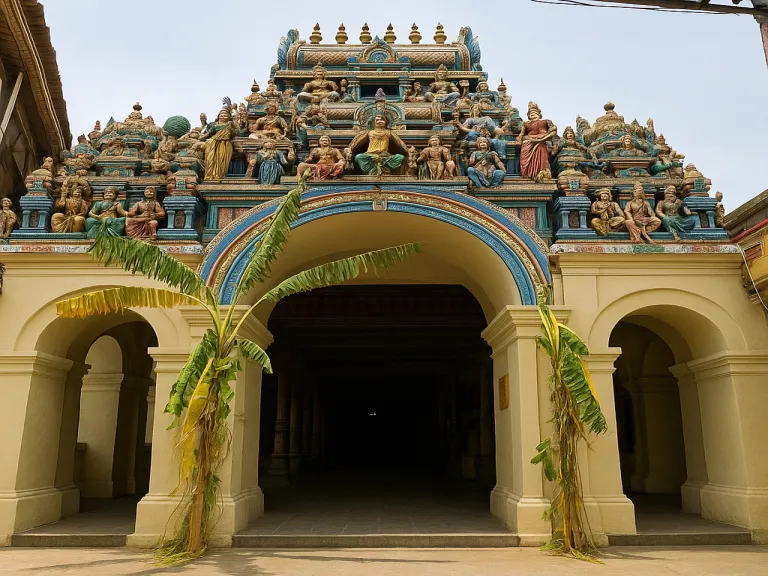
Punnainallur Mariamman Temple follows the general pattern of Tamil Dravidian temple architecture adapted for an Amman shrine. The temple has a sanctum for the presiding goddess, mandapams for worship and congregation, enclosing prakaras, subsidiary shrines, and a temple entrance marked by a gopuram. The layout supports both daily worship and large gatherings during festival days, when devotees assemble for darshan, offerings, and processions of the goddess.
The most distinctive architectural and ritual feature is the main image of Mariamman in the sanctum. The goddess is connected with an anthill form and is not treated like an ordinary stone icon. Because of this, direct abhishekam to the main deity is not part of the regular ritual practice; ablutions are performed to the utsava murti, the processional form of the goddess. The sanctum therefore preserves the sacred earthen presence while allowing the full cycle of worship through the festival image.
The temple’s built environment reflects the religious patronage of the Thanjavur Maratha period and later renovations made to accommodate continuous public worship. Its architectural importance lies less in monumental scale than in the integration of royal patronage, village goddess worship, and formal temple ritual. The mandapams and open spaces allow devotees to perform vows, offer prayers, and participate in festival observances. As a living temple, its architecture is experienced through movement: entry through the gopuram, circumambulation, darshan of the goddess, and participation in the devotional practices associated with Mariamman worship.
Temple Highlights
Historic Maratha Association
The temple is associated with Venkoji, or Ekoji I, the Maratha ruler of Thanjavur, and with later Maratha royal devotion.
Anthill Form of the Goddess
The presiding deity is connected with an anthill form, making the shrine ritually distinctive among Mariamman temples.
Healing Tradition
Devotees worship the goddess for relief from illness, eye ailments, skin afflictions, fear, and family difficulties.
Punnainallur Location
The temple is situated near Thanjavur, making it an important sacred destination in the Cauvery delta region.
Muthu Mariamman Worship
The goddess is revered as Sri Muthu Mariamman, a compassionate mother goddess and guardian deity.
Spiritual Benefits
- Devotees seek relief from illness and physical suffering.
- Devotees pray for protection from fever, pox, and epidemic-related fears associated with Mariamman worship.
- Devotees seek blessings for eye-related ailments, connected with the temple’s royal healing tradition.
- Devotees pray for the welfare and protection of children.
- Devotees seek family peace and removal of domestic difficulties.
- Devotees pray for courage during fear, uncertainty, and distress.
- Devotees seek the compassionate grace of the mother goddess for overall well-being.
Major Festivals
Aadi Fridays
Fridays in the Tamil month of Aadi are important for Amman worship, and devotees visit the temple in large numbers for the blessings of Mariamman.
Navaratri
Navaratri is observed as a major period of goddess worship, with special devotion to the mother goddess.
Annual Amman Festival
The temple observes annual festival worship for Sri Mariamman, drawing devotees for darshan, offerings, and processional celebrations.
Special Poojas
Archana to Sri Muthu Mariamman
Devotees offer archana to the goddess for personal prayers, family welfare, and fulfilment of vows.
Abhishekam to Utsava Murti
Because the main deity is associated with an anthill form, ablution rituals are performed to the processional image of the goddess.
How to Reach
By Road
Punnainallur is located near Thanjavur and can be reached by road from Thanjavur town by local buses, taxis, and private vehicles.
By Rail
The nearest major railway station is Thanjavur Junction, from where road transport is available to Punnainallur.
By Air
The nearest airport is Tiruchirappalli International Airport, from where travelers can reach Thanjavur and continue by road to Punnainallur.
Nearby Temples
Brihadeeswarar Temple, Thanjavur
about 7 km
A monumental Chola temple dedicated to Lord Shiva and one of the Great Living Chola Temples.
Bangaru Kamakshi Amman Temple, Thanjavur
about 7 km
A revered Amman temple in Thanjavur associated with the worship of Goddess Kamakshi.
Thanjapureeswarar Temple, Thanjavur
about 7 km
A Shiva temple in Thanjavur connected with the sacred and historical landscape of the town.
Aiyarappar Temple, Thiruvaiyaru
about 17 km
A major Shiva temple at Thiruvaiyaru, revered in the Tamil Saiva tradition.
Thingalur Chandran Temple
about 25 km
A temple associated with Chandran, the Moon, and included in the Navagraha pilgrimage circuit of the region.
Related Temples
Samayapuram Mariamman Temple
Associated in the temple tradition connected with Venkoji’s devotion to Mariamman.
Brihadeeswarar Temple, Thanjavur
Major nearby Thanjavur temple within the same regional pilgrimage circuit.
Visitor Tips
-
Visit early in the day or outside peak festival hours if you prefer a calmer darshan experience.
-
Wear modest clothing suitable for a traditional Hindu temple.
-
Expect larger crowds on Fridays, during Aadi, and during major Amman festival periods.
-
Carry drinking water during hot months, as Thanjavur can be very warm.
-
Check current temple timings locally before planning a special visit, as timings may change on festival days.
-
Maintain silence and follow the queue system inside the temple premises.
-
Do not photograph inside restricted areas unless temple authorities clearly permit it.
-
Combine the visit with nearby Thanjavur temples if planning a pilgrimage itinerary.

 WhatsApp Us