🛕About Temple
Peruvudaiyar Temple at Gangaikonda Cholapuram, more widely known as the Brihadisvara Temple or Gangaikondacholisvaram, is a major Shiva temple in Ariyalur district, Tamil Nadu. It was created as the central royal shrine of Gangaikonda Cholapuram, the imperial capital founded by Rajendra Chola I. The temple is dedicated to Shiva as a great linga and remains one of the most important monuments of the Chola period.
The temple forms part of the UNESCO World Heritage property known as the Great Living Chola Temples, along with the Brihadisvara Temple at Thanjavur and the Airavatesvara Temple at Darasuram. Although the surrounding palace, city walls, and much of the historic capital have disappeared, the main temple survives as a powerful statement of Chola kingship, devotion, engineering, and sculptural refinement.
Gangaikonda Cholapuram means the city of the Chola who brought the Ganga. The name commemorates Rajendra Chola I’s northern expedition and the ceremonial bringing of Ganga water to his new capital. The temple is not merely a place of worship but also a monument of political memory, linking sacred Shaiva worship with the imperial reach of the Chola state. Its serene setting, monumental vimana, massive linga, Nandi, and refined stone sculpture make it one of the finest expressions of South Indian temple art.
ℹ️Temple Information
🛕
Presiding Deity
Gangaikondacholisvarar
👸
Goddess
Periyanayaki Amman
⭐
Temple Type
Shaiva temple, Dravidian temple, Chola temple, UNESCO World Heritage monument, Living temple
📅
Built Period
11th century CE, around 1035 CE
Need Help Planning your visit to
Arulmigu Peruvudaiyar Temple?
Our travel experts can help you with transportation,
darshan timings, nearby sightseeing and complete temple tour planning.
⭐Temple Significance
The temple is significant as the royal Shiva temple of Rajendra Chola I’s capital, Gangaikonda Cholapuram, and as one of the Great Living Chola Temples recognized by UNESCO. It represents the political, religious, and artistic height of the Chola empire and preserves one of the finest examples of mature Dravidian architecture.
📜History
The Peruvudaiyar Temple at Gangaikonda Cholapuram was built by Rajendra Chola I in the 11th century CE after he established a new capital to celebrate Chola power and his successful northern campaigns. Rajendra, son and successor of Rajaraja Chola I, ruled over a vast empire that extended across much of South India and had maritime influence in Sri Lanka and Southeast Asia. The temple was conceived as the royal shrine of this new capital.
The foundation of Gangaikonda Cholapuram followed the model of Thanjavur, where Rajendra’s father had built the great Brihadisvara Temple. Rajendra’s temple, however, is not a direct copy. It adapts the architectural idea of a grand Shiva temple and gives it a softer, more sculptural form. The temple’s name, Gangaikondacholisvaram, connects Shiva, the king, and the imperial achievement symbolized by the Ganga. Inscriptions and historical studies identify it as a major Chola monument.
Gangaikonda Cholapuram remained an important Chola capital for generations after Rajendra I. Over time, political change, warfare, and the decline of the Chola state reduced the city’s importance. Many structures associated with the royal capital disappeared, but the temple survived. It is now protected as a historic monument and continues to be revered as a living Shaiva shrine. Its inclusion in the Great Living Chola Temples recognizes both its architectural importance and its continuity of sacred use.
🕉️Mythology
The mythology and sacred memory of Gangaikonda Cholapuram are closely connected with the Ganga, the river regarded in Hindu tradition as supremely purifying and associated with Shiva. In sacred narratives, Shiva receives the descent of the Ganga in his matted locks and releases her to the earth. At Gangaikonda Cholapuram, the royal act of bringing Ganga water to the south was given religious meaning through the consecration of a great Shiva temple.
Local tradition connects Rajendra Chola I’s northern campaign with the ritual use of Ganga water in the new capital. The city’s name, Gangaikonda Cholapuram, preserves this memory. The king’s victory was not remembered only as a military achievement but as an offering placed under the authority of Shiva. The great linga of the temple therefore stands at the center of a sacred landscape in which royal power is transformed into devotion.
The temple also carries the broader Shaiva symbolism found in major South Indian Shiva temples. The linga represents Shiva as the formless cosmic principle, while the sanctum signifies the spiritual center of the universe. The Nandi facing the sanctum embodies devotion and disciplined attention toward Shiva. Sculptures of deities, guardians, and Shaiva forms around the temple express the idea that the shrine is a complete sacred cosmos. These mythological meanings are distinct from the documented historical fact of Rajendra Chola I’s foundation of the temple.
🏛Architecture
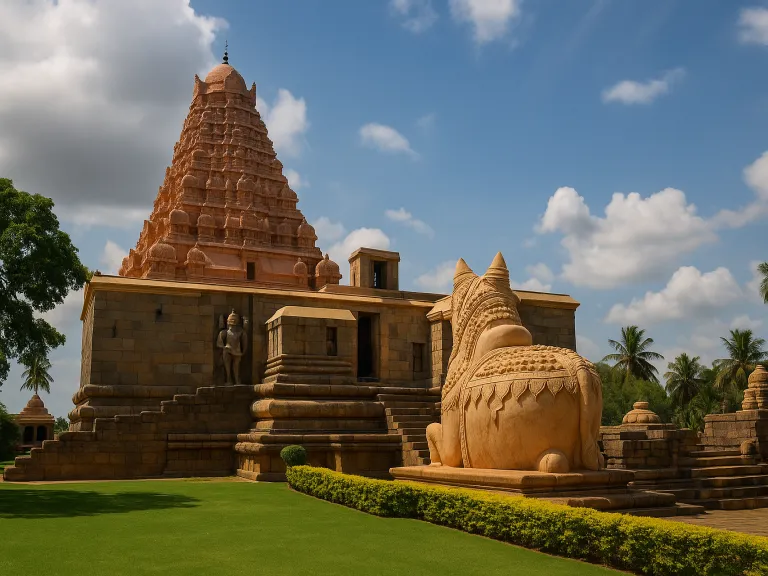
The architecture of Peruvudaiyar Temple at Gangaikonda Cholapuram belongs to the mature Chola phase of Dravidian temple building. The temple is built mainly of stone and is organized around a sanctum containing a large Shiva linga. Its most striking feature is the tall vimana over the sanctum, rising in receding tiers to a graceful summit. Compared with the Brihadisvara Temple at Thanjavur, the tower here is slightly lower and has a more curving, sculptural profile.
The layout includes a monumental sanctum, ardhamandapa, mahamandapa, subsidiary shrines, enclosure walls, and a large Nandi aligned with the main deity. The vimana is richly articulated with niches, pilasters, miniature shrines, and sculpted figures. The temple is celebrated for high-quality Chola sculpture, including images of Shiva in several forms, goddess figures, guardians, and devotional panels. The Chandesa Anugraha panel is especially admired as a refined example of Chola iconography and royal religious symbolism.
Architecturally, the temple demonstrates the Chola ability to combine mass and elegance. The structure is monumental without losing delicacy, and its sculptural surfaces soften the geometry of the tower. The temple was part of a much larger royal capital, but the surviving shrine still communicates the original imperial scale. Its design shows continuity with Thanjavur while also marking Rajendra Chola I’s distinct artistic statement. For this reason, it is one of the finest monuments of South Indian stone temple architecture.
🌳
Sacred Features
💧 Temple Tank
Chola Gangam (Ponneri)
Chola Gangam was the large reservoir created by Rajendra Chola I at Gangaikonda Cholapuram. It is historically associated with the capital and the commemoration of the king’s northern campaign and the bringing of Ganga water.
✨
Temple Highlights
✨
UNESCO World Heritage Monument
The temple is part of the Great Living Chola Temples, a UNESCO World Heritage property that also includes the Brihadisvara Temple at Thanjavur and the Airavatesvara Temple at Darasuram.
✨
Built by Rajendra Chola I
The temple was constructed in the 11th century CE by Rajendra Chola I as the principal Shiva shrine of his new imperial capital, Gangaikonda Cholapuram.
✨
Majestic Vimana
The sanctum is crowned by a tall Chola vimana known for its graceful, slightly curving profile and richly articulated stone tiers.
✨
Large Shiva Linga
The main sanctum enshrines Shiva as a large linga, reflecting the temple’s status as a major royal Shaiva shrine.
✨
Chola Sculpture
The temple contains refined sculptural panels and deity images that demonstrate the high level of Chola stone carving and iconographic skill.
✨
Chola Gangam Association
The temple and city are historically associated with the great water reservoir called Chola Gangam, created in memory of Rajendra Chola I’s northern campaign.
🙏
Spiritual Benefits
Devotees worship Shiva here for inner strength and clarity.
The temple is regarded as a sacred place for seeking the blessings of Shiva and Parvati.
Worship of the linga is associated with devotion to the formless aspect of Shiva.
Prayers at the shrine are valued for peace of mind and spiritual discipline.
The presence of Nandi facing the sanctum encourages focused and steady devotion.
The sacred association with the Ganga symbolizes purification and renewal.
Visits to this Chola shrine inspire reverence for dharma, art, and sacred knowledge.
🎉
Major Festivals
🎉
Maha Shivaratri
A major festival dedicated to Shiva, observed with special worship and devotion at Shaiva temples including Gangaikonda Cholapuram.
🎉
Aippasi Annabhishekam
A Shaiva observance in the Tamil month of Aippasi in which the Shiva linga is ceremonially covered with cooked rice as an offering.
🎉
Pradosham
A recurring Shaiva observance connected with worship of Shiva and Nandi, performed on the thirteenth lunar day of each fortnight.
🎉
Thiruvathirai
A festival associated with Shiva, especially Nataraja, observed in the Tamil month of Margazhi in many Shaiva temples.
🪔
Special Poojas
🪔
Abhishekam
Ritual bathing of the Shiva linga with sacred substances as part of Shaiva worship.
🪔
Pradosha Puja
Special worship of Shiva and Nandi performed during Pradosham, an important Shaiva observance.
🪔
Annabhishekam
A ceremonial offering in which the Shiva linga is covered with cooked rice, especially associated with the Tamil month of Aippasi.
🚗
How to Reach
🛣️
By Road
Gangaikonda Cholapuram is reachable by road from Jayankondam, Kumbakonam, Chidambaram, and Ariyalur. Buses and private vehicles connect the area with nearby towns.
🚆
By Rail
The nearest major railway access is through Kumbakonam or Ariyalur, from where the temple can be reached by road.
✈️
By Air
The nearest major airport is Tiruchirappalli International Airport, from where the temple is reached by road via Ariyalur, Kumbakonam, or Jayankondam routes.
💡
Visitor Tips
Verify current worship timings locally before planning the visit.
Visit during the cooler months between November and February for a more comfortable experience.
Carry drinking water, especially during summer months.
Respect the sanctity of the shrine and follow instructions given by temple or monument staff.
Allow enough time to observe the vimana, sculptures, Nandi, and surrounding architectural details.
Use local road transport from Jayankondam, Kumbakonam, Chidambaram, or Ariyalur depending on your route.
Ask the authorities on site before photographing restricted areas or interiors.
Combine the visit with other Chola monuments if planning a heritage itinerary.

 WhatsApp Us