About Temple
Shree Thanumalayan Swamy Temple, also called Sthanumalayan Temple, is a celebrated Hindu temple at Suchindram in Kanyakumari district, Tamil Nadu. The temple is famous for its central deity, Sthanumalayan, a sacred form in which Sthanu represents Shiva, Mal represents Vishnu, and Ayan represents Brahma. This rare theological identity makes the shrine important to devotees who worship the Trimurti as a unified divine presence. Suchindram lies on the road between Nagercoil and Kanyakumari and has long been part of the cultural landscape of Nanjil Nadu.
The temple is known for its strong ritual life, monumental gateway tower, sculptural wealth, musical pillars, large Nandi, and the revered Hanuman image within the complex. Though the presiding deity is identified through a Shaiva linga form, the temple’s religious meaning embraces Shiva, Vishnu, and Brahma together. This has made Suchindram a major pilgrimage centre for devotees from Tamil Nadu and Kerala, especially because of its location near the historical boundary of Tamil and Malayalam cultural regions.
The temple combines sacred mythology, early medieval inscriptions, later royal patronage, and living worship traditions. It is associated with stories of Indra’s purification and the chastity of Anasuya, while its recorded history shows continued development under regional rulers, especially the Venad and Travancore lineages. Today, Thanumalayan Swamy Temple remains one of the most distinctive temples in southern Tamil Nadu, valued for worship, architecture, sculpture, music, and the rare idea of the three principal deities being worshipped in a single sacred form.
Temple Significance
The temple is significant for the worship of Sthanumalayan, a rare sacred form representing Shiva, Vishnu, and Brahma together. It is also important for its association with Suchindram mythology, its historic role in Nanjil Nadu, its Travancore-period patronage, and its celebrated artistic features such as the musical pillars, monumental gopuram, large Nandi, and Hanuman shrine.
History
The historical record of Shree Thanumalayan Swamy Temple is not attached to a single named founder. The temple developed over many centuries in Suchindram, an important settlement in the old Nanjil Nadu region near the southern tip of the Indian peninsula. Stone inscriptions and temple records show that the shrine received gifts, endowments, and structural additions across the medieval and early modern periods. Its antiquity is therefore understood through accumulated evidence rather than through one foundation event.
Suchindram came under the influence of the Venad and later Travancore rulers, whose political and cultural authority extended over Nanjil Nadu for long periods. The temple’s present form reflects phases of renovation, enlargement, and patronage by regional rulers, local elites, and temple administrators. The architectural language also shows the wider South Indian idiom of Dravidian temple building, while the temple’s location close to Kerala contributed to cultural interactions in ritual practice, administration, and patronage.
The standing temple is especially known for early modern additions, including its tall gopuram, extensive mandapas, rich sculptures, and celebrated musical pillars. The temple remained a major religious institution under the Travancore state and continued to serve the surrounding communities through daily worship and annual festivals. In historical terms, its significance lies not only in the age of the shrine but also in the continuity of patronage and ritual. The documented history of Suchindram presents the temple as a long-lived sacred centre shaped by medieval devotion, Travancore support, local endowments, and the enduring identity of Sthanumalayan as a unique Trimurti deity.
Mythology
The mythology of Suchindram is closely connected with the meaning of the place name and the sanctity of purification. In temple tradition, Indra incurred sin and came to this place to perform worship and penance. After being purified here, the place became known as Suchindram, from the idea of becoming clean or pure. This story gives the temple a strong association with removal of impurity, restoration of divine grace, and the power of sincere worship.
Another important myth links the temple with the sage Atri and his wife Anasuya, whose chastity and spiritual strength are praised in Hindu sacred literature. In the Suchindram tradition, the three deities Brahma, Vishnu, and Shiva came to test Anasuya. Through her power of virtue, she transformed them into infants. The gods were later restored, and their combined presence became associated with the deity worshipped at Suchindram. This explains the special name Sthanumalayan, where Sthanu, Mal, and Ayan refer to Shiva, Vishnu, and Brahma.
These mythological narratives are distinct from the temple’s historical development, but they remain central to the living identity of the shrine. They explain why the temple is not understood as belonging exclusively to one single deity-form in the ordinary sense. Devotees approach Sthanumalayan as a unifying manifestation of the Trimurti, and the temple’s legends emphasize purity, devotion, virtue, and divine unity. The presence of Hanuman within the complex also deepens the devotional character of the temple, connecting the shrine with broader Hindu worship traditions followed across South India.
Architecture
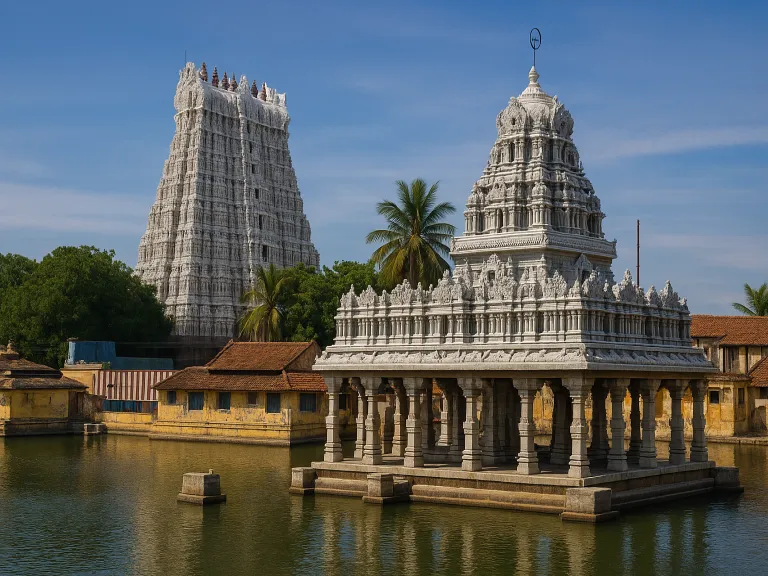
Shree Thanumalayan Swamy Temple is a major example of South Indian temple architecture in the far south of Tamil Nadu. The temple complex is organized around the sanctum of Sthanumalayan and includes enclosing walls, mandapas, subsidiary shrines, sculptural panels, and a prominent gopuram. The tall white entrance tower, visible from the surrounding settlement, is one of the most recognized features of the temple. Its tiers are filled with stucco figures and religious imagery typical of Dravidian temple towers.
The interior is famous for its stone craftsmanship. The temple contains finely carved pillars, sculptural images of deities and guardians, and mandapas used for worship and festival activities. One of its best-known architectural features is the group of musical pillars, which produce different tones when gently tapped. Such pillars are admired as examples of technical skill in stone carving and are among the features that draw visitors interested in art history as well as devotion.
The temple is also noted for its large Nandi image and the revered Hanuman image within the complex. These monumental icons add to the temple’s visual and devotional impact. The plan and decorative programme reflect several phases of construction rather than a single building campaign, with later additions layered onto an older sacred centre. The result is a temple that combines sacred symbolism, royal patronage, sculptural artistry, and living ritual space. Its architecture communicates the temple’s central idea: the convergence of Shiva, Vishnu, and Brahma in the sacred presence of Sthanumalayan.
Temple Highlights
Trimurti Deity of Sthanumalayan
The presiding deity represents Sthanu, Mal, and Ayan, identified with Shiva, Vishnu, and Brahma in a single sacred form.
Suchindram Mythology
The temple is associated with the purification of Indra and with the legend of Anasuya, Atri, and the three principal deities.
Musical Pillars
The temple’s carved stone musical pillars are famous for producing distinct tones when gently struck.
Tall Entrance Gopuram
The prominent white gopuram with sculptural decoration is one of the most recognizable architectural features of the temple.
Hanuman Shrine
The temple complex contains a revered image of Hanuman, attracting devotees who offer worship for strength and devotion.
Large Nandi Image
A large Nandi within the temple is among the important sculptural and devotional features of the complex.
Spiritual Benefits
- Seeking the blessings of Shiva, Vishnu, and Brahma through one sacred form
- Worship connected with purification and removal of inner impurities
- Prayers for harmony, dharma, and righteous living
- Devotion to Hanuman for courage, strength, and steadfast faith
- Worship for family welfare and spiritual protection
- Reflection on the unity of divine principles in Hindu worship
- Participation in a living temple tradition of southern Tamil Nadu
Major Festivals
Margazhi Festival
A major annual festival observed during the Tamil month of Margazhi, attracting devotees for processions and special worship.
Chithirai Festival
A festival observed during the Tamil month of Chithirai with special rituals and temple celebrations.
Avani Festival
A temple festival observed during the Tamil month of Avani as part of the annual ritual calendar.
Hanuman Jayanti
Devotees offer special worship to Hanuman at the temple’s Hanuman shrine on Hanuman Jayanti.
Special Poojas
Daily Worship to Sthanumalayan Swamy
Regular temple worship is offered to the presiding deity, who represents Shiva, Vishnu, and Brahma.
Abhishekam
Ritual bathing of the deity is performed as part of temple worship on prescribed occasions.
Archana
Devotees offer archana with names and prayers according to temple practice.
Hanuman Worship
Special prayers are offered by devotees at the Hanuman shrine for strength, courage, and devotion.
How to Reach
By Road
Suchindram is on the road between Nagercoil and Kanyakumari. Buses, taxis, and local vehicles connect the temple with Nagercoil, Kanyakumari, and nearby towns.
By Rail
The nearest major railway station is Nagercoil Junction, from where Suchindram can be reached by road.
By Air
The nearest airport with regular commercial connectivity is Thiruvananthapuram International Airport in Kerala, from where the temple can be reached by road.
Nearby Temples
Nagaraja Temple, Nagercoil
about 7 km
A historic temple in Nagercoil dedicated to Nagaraja and connected with serpent worship traditions.
Kanyakumari Bhagavathy Amman Temple
about 13 km
A major coastal temple at Kanyakumari dedicated to Goddess Bhagavathy, an important pilgrimage destination.
Vattakottai and Kanyakumari temple circuit
about 15 km
The Kanyakumari region includes several shrines and pilgrimage points near the southern tip of India.
Adikesava Perumal Temple, Thiruvattar
about 35 km
An important Vishnu temple in Kanyakumari district, known for its historic and religious significance.
Related Temples
Kanyakumari Bhagavathy Amman Temple
Major nearby pilgrimage temple in Kanyakumari district.
Nagaraja Temple, Nagercoil
Important nearby historic temple in Nagercoil.
Adikesava Perumal Temple, Thiruvattar
Major regional Vaishnavite temple in Kanyakumari district.
Visitor Tips
-
Confirm current temple timings locally before planning the visit.
-
Wear modest clothing suitable for a place of worship.
-
Remove footwear before entering designated temple areas.
-
Festival days can be crowded, so plan extra time for darshan.
-
Suchindram is close to Nagercoil and Kanyakumari and can be combined with nearby pilgrimage visits.
-
Respect restrictions placed by temple authorities regarding photography and mobile phone use.
-
Maintain silence and follow the queue system where provided.

 WhatsApp Us