🛕About Temple
Ekambareshwarar Temple, widely known as Ekambareswarar or Ekambaranathar Temple, is one of the most important Shiva temples in Kanchipuram, Tamil Nadu. The presiding deity is Lord Shiva as Ekambareswarar, worshipped in the form of a lingam associated with the earth element. The temple is counted among the Pancha Bhoota Sthalams, the five great Shiva shrines representing the five natural elements, and this temple represents Prithvi, or earth.
Kanchipuram has been an ancient centre of Shaiva, Vaishnava and Shakta worship, and Ekambareswarar Temple is among its largest and most prominent sacred complexes. The temple is also revered as a Paadal Petra Sthalam, praised in the Tamil Tevaram hymns of the Nayanmar saints. Its importance rests on both its liturgical status and its deep connection with the sacred geography of Kanchipuram.
The temple is especially associated with Goddess Parvati’s worship of Shiva beneath a mango tree, a theme that is central to its mythology and ritual identity. The shrine draws pilgrims for darshan of the Prithvi Lingam, the towering eastern rajagopuram, the long pillared halls and the sacred mango tree within the complex. It remains a living place of worship where daily pujas, festival processions and annual celebrations continue the Shaiva traditions of Kanchipuram.
ℹ️Temple Information
🛕
Presiding Deity
Ekambareswarar
👸
Goddess
Elavarkuzhali Amman
⭐
Temple Type
Shiva temple, Pancha Bhoota Sthalam, Paadal Petra Sthalam, Dravidian temple, Living temple
📅
Built Period
At least 7th century CE as a celebrated Tevaram shrine; major structural and monumental additions from the Chola period through the 16th century CE.
🏛
Dynasty
Pallava, Chola and Vijayanagara
Need Help Planning your visit to
Ekambareshwarar Temple?
Our travel experts can help you with transportation,
darshan timings, nearby sightseeing and complete temple tour planning.
⭐Temple Significance
Ekambareswarar Temple is one of the Pancha Bhoota Sthalams and represents the earth element, Prithvi. It is also a Paadal Petra Sthalam praised in the Tevaram hymns and one of the foremost Shiva temples of Kanchipuram.
📜History
Ekambareswarar Temple is historically attested as an ancient Shaiva shrine of Kanchipuram and is celebrated in the Tevaram hymns of the 7th-century Nayanmars, including Appar, Sambandar and Sundarar. This establishes the temple’s importance by the early medieval period. Kanchipuram was a major religious and political centre under the Pallavas, and the shrine formed part of the city’s long-standing sacred landscape.
The temple received patronage and structural additions over several centuries. The Chola period contributed to the growth of many stone temples in Kanchipuram, and inscriptions and architectural layers connect the shrine with the wider Chola-era development of temple institutions. Later, the Vijayanagara rulers made major additions that shaped much of the present monumental appearance of the complex.
The tall eastern rajagopuram is strongly associated with the Vijayanagara period, particularly the reign of Krishnadevaraya in the early 16th century. The temple’s large enclosures, pillared halls and festival infrastructure reflect the cumulative patronage of different South Indian dynasties rather than a single act of construction. Its historical identity is therefore best understood as an ancient shrine expanded by Pallava, Chola and Vijayanagara patrons, with the Vijayanagara phase providing some of its most visible architectural features today.
🕉️Mythology
The central mythology of Ekambareswarar Temple links the shrine with Goddess Parvati’s penance for Lord Shiva. In the sacred story, Parvati fashioned a lingam out of earth and worshipped it beneath a mango tree in Kanchipuram. Because the lingam was made of earth, the temple became associated with the Prithvi element among the Pancha Bhoota Sthalams.
Another part of the legend describes a flood that threatened the earthen lingam. Parvati embraced the lingam to protect it from being washed away, and Shiva accepted her devotion. This episode is central to the temple’s sacred identity and explains the intimate connection between the deity, the earth element, the mango tree and the goddess. The name Ekambareswarar is commonly understood in relation to the single mango tree associated with the shrine.
The temple’s mythology also connects Kanchipuram with the divine marriage of Shiva and Parvati. The annual Panguni festival celebrates this sacred union, and devotees worship at the temple for blessings connected with marriage, family welfare, stability and devotion. These narratives belong to the sacred tradition of the temple and are distinct from the historical record of dynastic patronage and architectural expansion.
🏛Architecture
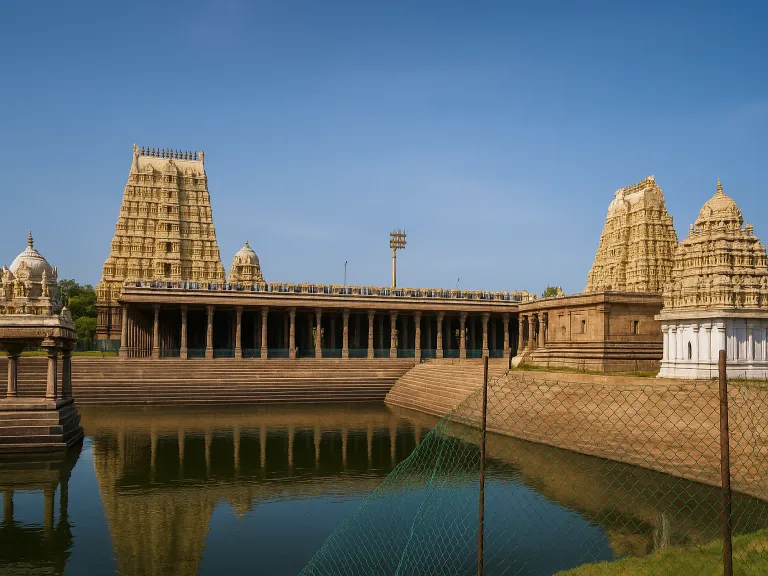
Ekambareswarar Temple is one of the largest temple complexes in Kanchipuram and displays the Dravidian architectural idiom developed across many centuries. The most striking feature is the lofty eastern rajagopuram, a multi-tiered gateway tower associated with the Vijayanagara period. The temple complex includes multiple prakaras, mandapas, subsidiary shrines, processional spaces and sacred water features arranged around the principal shrine.
The sanctum houses the Prithvi Lingam of Ekambareswarar, and the temple’s plan supports both daily worship and large festival processions. The pillared halls reflect the mature South Indian temple tradition, with long corridors and sculptural elements used for ritual movement, gatherings and ceremonial functions. Vijayanagara-period contributions are especially visible in the monumental scale of the gateway and mandapas.
A distinctive sacred feature of the complex is the mango tree connected with the legend of Parvati’s worship. The temple’s architecture is not only monumental but also ritual-oriented: the gopuram marks the threshold, the prakaras organize circumambulation, the halls support collective worship, and the sanctum preserves the elemental identity of the shrine. The accumulated Pallava, Chola and Vijayanagara layers make the temple an important example of how South Indian sacred architecture developed through continuing patronage.
🌳
Sacred Features
🌳 Temple Tree
Mango tree
The mango tree is the sthala vriksha of the temple and is central to the mythology of Goddess Parvati worshipping the earthen lingam of Shiva beneath it.
💧 Temple Tank
Sivaganga Theertham
The temple tank is a sacred water feature associated with ritual purification and worship within the temple complex.
✨
Temple Highlights
✨
Pancha Bhoota Sthalam for Earth
The temple represents Prithvi, the earth element, among the five great elemental Shiva temples of South India.
✨
Paadal Petra Sthalam
Ekambareswarar Temple is praised in the Tevaram hymns of the Nayanmar saints, giving it high importance in Tamil Shaiva tradition.
✨
Vijayanagara Rajagopuram
The monumental eastern gateway tower is one of the most recognizable architectural features of the temple and is associated with Vijayanagara patronage.
✨
Sacred Mango Tree
The temple’s sthala vriksha is connected with the mythology of Parvati worshipping Shiva beneath a mango tree.
✨
Panguni Festival
The annual Panguni celebration of the divine wedding of Shiva and Parvati is one of the temple’s major festivals.
🙏
Spiritual Benefits
Blessings of Lord Shiva as the Prithvi Lingam
Prayers for stability, patience and groundedness
Blessings for marriage and family harmony
Devotional connection with Shiva and Parvati
Participation in Shaiva worship and Tevaram tradition
Prayer for removal of obstacles through sincere devotion
Opportunity for circumambulation and worship in a major sacred Kanchipuram shrine
🎉
Major Festivals
🎉
Panguni Festival
The annual Panguni celebration is a major festival of the temple and is associated with the divine wedding of Lord Shiva and Goddess Parvati.
🎉
Maha Shivaratri
Maha Shivaratri is observed with special worship of Lord Shiva and draws devotees for night-long devotion and darshan.
🎉
Pradosham
Pradosham is observed regularly as an important Shaiva worship occasion dedicated to Lord Shiva.
🎉
Arudra Darshan
Arudra Darshan is an important Shaiva festival connected with the worship of Shiva and is observed in Tamil Shaiva temples.
🎉
Karthikai Deepam
Karthikai Deepam is celebrated in the Tamil month of Karthikai with lamps and worship dedicated to Shiva.
🪔
Special Poojas
🪔
Abhishekam
Ritual bathing of the deity is performed as part of Shiva worship according to temple practice.
🪔
Pradosha Puja
Special worship is offered during Pradosham, an important recurring occasion for devotees of Lord Shiva.
🪔
Somavara Puja
Monday worship is significant for Lord Shiva, and devotees visit the temple for darshan and prayers.
🪔
Maha Shivaratri Puja
Special worship and extended devotional observances are conducted for Maha Shivaratri.
🪔
Panguni Kalyana Utsavam
The ceremonial celebration of the divine wedding of Shiva and Parvati forms a major part of the Panguni festival.
🚗
How to Reach
🛣️
By Road
Kanchipuram is well connected by road to Chennai, Chengalpattu, Vellore and other towns in Tamil Nadu. Local buses, taxis and auto-rickshaws are available within Kanchipuram.
🚆
By Rail
Kanchipuram has a railway station with train connections to Chennai and nearby junctions. The temple can be reached from the station by local transport.
✈️
By Air
The nearest major airport is Chennai International Airport. From Chennai, Kanchipuram can be reached by road or rail.
💡
Visitor Tips
Visit early in the morning or in the evening to avoid peak heat.
Wear modest clothing suitable for an active Hindu temple.
Allow sufficient time to walk through the large temple complex.
Check current temple timings locally before planning special darshan or festival visits.
During Panguni and Maha Shivaratri, expect larger crowds and longer waiting times.
Respect restrictions around the sanctum and follow instructions from temple staff.
Combine the visit with other major Kanchipuram temples if time permits.

 WhatsApp Us