🛕About Temple
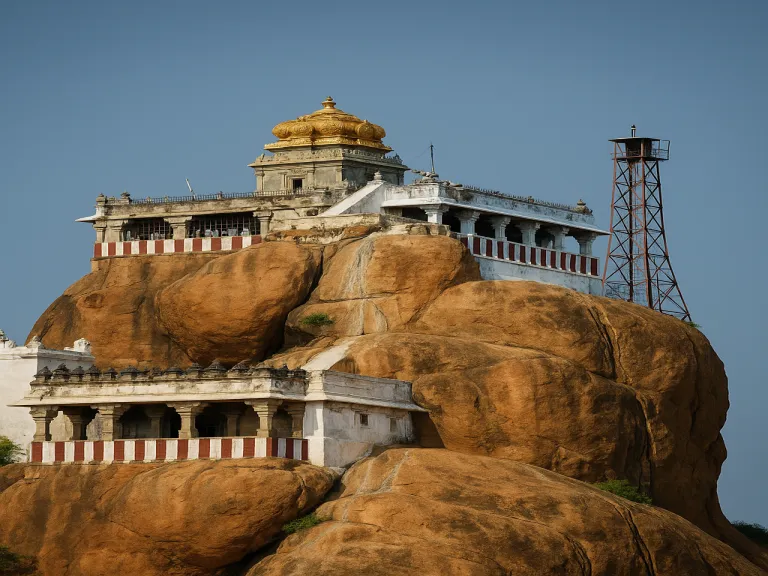
Uchi Pillaiyar Temple is a prominent Ganesha shrine located on the summit of the Rockfort hill in Tiruchirappalli, Tamil Nadu. The name “Uchi Pillaiyar” means “Pillaiyar at the top,” referring to the temple’s position at the highest accessible point of the rocky hill. The shrine is part of the larger Rockfort temple complex, which also includes Manikka Vinayagar Temple at the base and Thayumanaswamy Temple on the ascent.
The temple is best known for its dramatic setting above the city. Devotees and visitors reach the shrine by climbing a long series of rock-cut and built steps through the historic hill complex. From the summit, there are wide views of Tiruchirappalli, the Kaveri river region, Srirangam, and the surrounding plains. The hill itself is a major landmark of the city and has religious, historical, and military associations.
Uchi Pillaiyar is worshipped as a form of Lord Ganesha, the remover of obstacles and the deity invoked at the beginning of auspicious undertakings. The shrine’s identity is closely linked with the well-known local mythology connecting Ganesha, Vibhishana, and the Ranganatha image of Srirangam. While the mythology explains the temple’s sacred character, the site’s documented historical layers belong to the Rockfort complex, which contains Pallava-period rock-cut shrines and later fortifications associated with medieval and early modern powers.
ℹ️Temple Information
🛕
Presiding Deity
Uchi Pillaiyar
⭐
Temple Type
Ganesha temple, Hill temple, Rockfort temple, Hindu temple
📅
Built Period
The Rockfort complex contains Pallava-period rock-cut shrines from the 6th-7th century CE; the exact construction period of the present Uchi Pillaiyar summit shrine is not securely documented.
🏛
Dynasty
Pallava period rock-cut monuments are documented in the Rockfort complex; later Nayak fortification and patronage are associated with the hill complex.
Need Help Planning your visit to
Arulmigu Uchi Pillaiyar Temple?
Our travel experts can help you with transportation,
darshan timings, nearby sightseeing and complete temple tour planning.
⭐Temple Significance
Uchi Pillaiyar Temple is significant as the hilltop Ganesha shrine of Tiruchirappalli Rockfort, a major city landmark and sacred site. It is revered for its association with Lord Ganesha, the mythology of Vibhishana and Srirangam, and its position within a historically layered hill complex that includes Pallava-period rock-cut monuments.
📜History
The Rockfort hill of Tiruchirappalli is one of the oldest and most historically important landmarks in the city. Its religious history is documented through the Pallava-period rock-cut shrines in the hill complex, especially the cave temple associated with Mahendravarman I. These rock-cut monuments show that the hill was an established sacred site by the early medieval period. The summit shrine of Uchi Pillaiyar forms part of this wider hill-temple environment.
The Rockfort complex developed through multiple historical phases. The Pallavas contributed rock-cut architecture, while later rulers and local powers added temples, steps, mandapas, and fortification-related structures. The hill’s strategic location in the Kaveri delta made it important not only as a religious centre but also as a defensive and political site. Tiruchirappalli later came under the influence of Cholas, Pandyas, Vijayanagara rulers, Nayaks, and early modern powers.
During the Nayak period, Tiruchirappalli became a major fortified centre, and the Rockfort hill acquired greater military importance. In the eighteenth century, the fort and its surroundings were involved in conflicts connected with the Carnatic wars. The Uchi Pillaiyar shrine, however, remains primarily a devotional space within this historically layered site. The exact builder and construction date of the present summit Ganesha shrine are not securely documented in widely established historical sources, so its history is best understood within the broader development of the Rockfort temple complex.
🕉️Mythology
The mythology of Uchi Pillaiyar Temple is connected with the story of Vibhishana, the younger brother of Ravana, and the sacred image of Lord Ranganatha. According to the temple tradition, after the events of the Ramayana, Rama gave Vibhishana the image of Ranganatha as a divine gift. Vibhishana carried it southward toward Lanka, intending to install and worship it there.
When Vibhishana reached the Kaveri region, the gods wanted the Ranganatha image to remain in the sacred land that later became Srirangam. Lord Ganesha appeared in the form of a young boy and offered to hold the image while Vibhishana performed his duties. Ganesha placed the image on the ground, and it became fixed there. This act led to the establishment of Lord Ranganatha at Srirangam, one of the most important Vaishnava sacred centres.
Vibhishana, angered by the boy’s action, chased him. Ganesha climbed the rocky hill at Tiruchirappalli and reached the top. The summit shrine of Uchi Pillaiyar is associated with this event. The mythology explains why Ganesha is worshipped on the hilltop and why the temple is linked in sacred memory with Srirangam. This narrative belongs to local religious tradition and should be understood separately from the documented historical development of the Rockfort complex.
🏛Architecture
Uchi Pillaiyar Temple is architecturally distinctive because of its hilltop setting on the Rockfort of Tiruchirappalli. The shrine is reached by climbing through the rock complex, passing built and rock-cut sections associated with different historical periods. The temple’s compact sanctum stands at the summit, making the approach, elevation, and landscape central to the experience of worship. The ascent itself is an important architectural and devotional feature.
The Rockfort complex contains significant early medieval rock-cut architecture. The cave shrines on the hill, especially those associated with the Pallava period, demonstrate the importance of Tiruchirappalli in the development of South Indian rock-cut temple traditions. These monuments are separate from the small summit shrine but form the documented architectural context in which Uchi Pillaiyar is situated. Later structural additions, steps, halls, and protective elements reflect continuing use of the hill as a sacred and strategic place.
The temple does not present the large gopurams or spacious prakaras seen in major plains temples; instead, its architectural identity is shaped by the natural rock, steep climb, and commanding summit position. The worship space is relatively modest, but the location gives it exceptional visual prominence. From the top, devotees can see the Kaveri region, Srirangam, and much of Tiruchirappalli, making the temple a rare example where sacred architecture, geology, urban identity, and mythology are inseparably connected.
✨
Temple Highlights
✨
Hilltop Ganesha shrine
The temple is dedicated to Lord Ganesha and stands at the summit of the Rockfort hill, giving it the name Uchi Pillaiyar.
✨
Rockfort setting
The shrine is part of the historic Tiruchirappalli Rockfort complex, one of the best-known landmarks of the city.
✨
Association with Srirangam mythology
The temple tradition connects Uchi Pillaiyar with the story of Vibhishana, Ganesha, and the installation of Lord Ranganatha at Srirangam.
✨
Pallava rock-cut context
The hill complex contains documented Pallava-period rock-cut shrines, adding historical importance to the sacred landscape.
✨
Panoramic city views
The summit offers views of Tiruchirappalli, the Kaveri region, and Srirangam.
🙏
Spiritual Benefits
Worship of Lord Ganesha for removal of obstacles
Blessings for auspicious beginnings
Prayer for clarity before important decisions
Devotional strength through the hill climb and darshan
Blessings for education and learning
Prayer for family welfare
Spiritual connection with the sacred geography of Tiruchirappalli and Srirangam
🎉
Major Festivals
🎉
Vinayaka Chaturthi
Vinayaka Chaturthi is the principal festival associated with Lord Ganesha. Devotees worship Uchi Pillaiyar with special devotion during this festival.
🎉
Sankatahara Chaturthi
Sankatahara Chaturthi, the monthly observance dedicated to Lord Ganesha, is an important day of worship for devotees seeking removal of obstacles.
🪔
Special Poojas
🪔
Ganesha worship and archanai
Devotees offer prayers to Uchi Pillaiyar seeking removal of obstacles and blessings for auspicious beginnings.
🪔
Vinayaka Chaturthi special worship
Special worship is associated with Vinayaka Chaturthi, the major festival dedicated to Lord Ganesha.
🚗
How to Reach
🛣️
By Road
Uchi Pillaiyar Temple is in central Tiruchirappalli at the Rockfort. The area is accessible by city buses, taxis, and auto-rickshaws from major parts of the city.
🚆
By Rail
Tiruchirappalli Junction is the main railway station serving the city. From the station, visitors can reach Rockfort by road.
✈️
By Air
Tiruchirappalli International Airport is the nearest airport. From the airport, visitors can travel by road to the Rockfort area.
💡
Visitor Tips
Be prepared to climb steps to reach the summit shrine.
Visit during cooler hours if you want to avoid heat during the ascent.
Confirm current temple timings locally before planning the visit.
Remove footwear where required before entering shrine areas.
Carry drinking water for the climb, especially in warm weather.
Use caution on steps during rain, as stone surfaces may become slippery.
Combine the visit with Manikka Vinayagar Temple and Thayumanaswamy Temple in the same Rockfort complex.
Respect worshippers and avoid blocking narrow passages during crowded periods.

 WhatsApp Us