🛕About Temple
Padaleeswarar Temple at Tirupathiripuliyur in Cuddalore, Tamil Nadu, is an ancient Shaiva temple dedicated to Lord Shiva as Padaleeswarar. The shrine stands in the historic temple-town area of Tirupathiripuliyur, close to Cuddalore town and the Tirupathiripuliyur railway station. It is counted among the Paadal Petra Sthalams, the sacred Shiva temples praised in the Tevaram hymns of the Tamil Shaiva saints.
The presiding deity is worshipped as a Shiva lingam, and the goddess is worshipped as Periyanayaki, also known as Brihannayaki. The name Tirupathiripuliyur is associated with the padiri tree and the sacred lore of Vyaghrapada, the tiger-footed sage. The temple is especially important in the devotional geography of northern Tamil Nadu because of its connection with the Nayanmars and with the growth of Tamil Shaiva bhakti.
The temple remains an active place of worship, with daily pujas, festival worship, and regular visits by devotees from Cuddalore, Puducherry, Chidambaram, Panruti, and nearby regions. Its sanctity rests on a combination of Tevaram praise, local sthala-purana traditions, a long continuity of worship, and its position within the larger network of ancient Shiva temples of the Cuddalore region. For pilgrims, it is both a historical shrine and a living center of Shaiva devotion.
ℹ️Temple Information
🛕
Presiding Deity
Padaleeswarar
⭐
Temple Type
Shiva temple, Paadal Petra Sthalam, Tevaram temple, Ancient Tamil Nadu temple
📅
Built Period
At least 7th century CE as a documented sacred site; the existing structural complex includes later medieval and post-medieval phases.
🏛
Dynasty
Pallava-period literary context; later Chola and subsequent South Indian temple patronage are associated with the region and the temple’s development.
Need Help Planning your visit to
Arulmigu Padaleeswarar Temple?
Our travel experts can help you with transportation,
darshan timings, nearby sightseeing and complete temple tour planning.
⭐Temple Significance
Padaleeswarar Temple is significant as a Tevaram Paadal Petra Sthalam, an ancient Shiva shrine praised by the Nayanmars. It is closely associated with Appar, the padiri sacred tree, and the sacred geography of Tirupathiripuliyur in Cuddalore.
📜History
Padaleeswarar Temple is historically significant because it is mentioned in the 7th-century Tamil Shaiva canon, the Tevaram. The hymns of the Nayanmar saints establish that the shrine was already a recognized sacred center during the early medieval period. Its association with Appar, also called Tirunavukkarasar, gives the temple an important place in the history of Tamil bhakti literature and the spread of Shaivism in the Pallava-period Tamil country.
The original builder of the temple is not conclusively established in widely documented historical sources. The shrine’s antiquity is confirmed by its Tevaram status, while the present masonry complex reflects the layered development typical of many ancient Tamil temples. Medieval South Indian temples often received expansions, endowments, and structural additions over several centuries, and Padaleeswarar Temple is connected with the broader history of Chola and later-period temple patronage in the region.
Tirupathiripuliyur’s location near Cuddalore also placed it within an important cultural zone between Chidambaram, Panruti, Thiruvathigai, and the coastal settlements of the Coromandel region. The temple’s continuing ritual life preserves the memory of the Nayanmars, especially Appar, whose hagiographical connection to this area is central to the temple’s identity. Historically, the shrine is best understood as an ancient Tevaram temple with early medieval textual evidence and later architectural growth through successive phases of Tamil temple culture.
🕉️Mythology
The mythology of Padaleeswarar Temple is centered on Lord Shiva’s grace at Tirupathiripuliyur and on the sanctity of the padiri tree. In local sthala-purana tradition, Goddess Parvati worshipped Shiva at this sacred place and received his blessing. The presence of the padiri tree is connected with the name of the place, and the temple’s identity is closely tied to this sacred botanical association.
Another important strand of temple lore links Tirupathiripuliyur with Sage Vyaghrapada, the tiger-footed sage renowned in Shaiva tradition for his intense devotion to Shiva. The element Puliyur in the place-name is associated with this sage. In the sacred geography of Tamil Shaivism, such names preserve mythic memories of sages, gods, and devotees who performed worship in particular locations.
The temple is also strongly associated with Appar in Saiva hagiography. The Periya Puranam narrates that Appar was persecuted by a Pallava ruler before the king’s conversion to Shaivism. One episode describes Appar being tied to a stone and cast into the sea; by Shiva’s grace, he survived and came ashore in the Cuddalore region. This sacred narrative is remembered in relation to Tirupathiripuliyur and nearby Karaiyeravittakuppam. While this belongs to religious tradition rather than political history, it is central to the devotional memory of the temple.
🏛Architecture
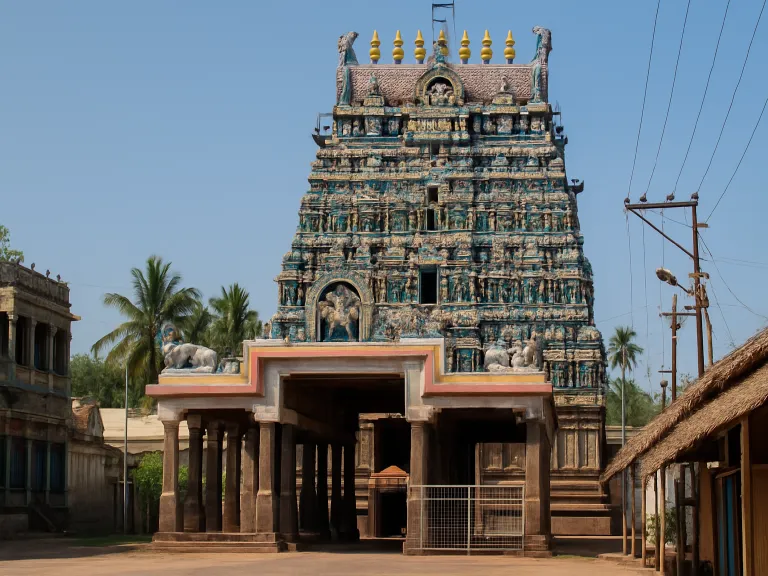
Padaleeswarar Temple follows the Dravidian architectural idiom of Tamil Shaiva temples. The complex is organized around the sanctum of Padaleeswarar, where the presiding deity is worshipped as a Shiva lingam. In the axial arrangement are the Nandi, balipeetham, and spaces used for ritual movement. The goddess Periyanayaki has her own shrine, emphasizing the paired worship of Shiva and Shakti that is central to Tamil temple practice.
The temple has a prominent entrance tower, enclosed prakaras, subsidiary shrines, mandapas, and sculptural elements associated with Shaiva worship. Devotees encounter images and shrines connected with Ganesha, Murugan, Chandikeswarar, the Nayanmars, and other deities commonly present in established Shiva temples. The architectural experience is shaped by circumambulation, darshan of the moolavar, worship at the goddess shrine, and participation in daily puja and festival rituals.
Like many ancient Tevaram shrines, the temple’s present form reflects cumulative construction rather than a single building event. The core sanctity is early, as shown by its inclusion in the Tevaram corpus, while the visible stone and structural features belong to later phases of South Indian temple development. The architecture is therefore significant not only as a built monument but also as a ritual environment that has supported continuous Shaiva worship over many centuries.
🌳
Sacred Features
🌳 Temple Tree
Padiri tree
The padiri tree is associated with the name and sacred identity of Tirupathiripuliyur and is central to the temple’s sthala-purana tradition.
✨
Temple Highlights
✨
Paadal Petra Sthalam
The temple is one of the sacred Shiva temples praised in the Tevaram hymns of the Tamil Shaiva saints.
✨
Association with Appar
Tirupathiripuliyur is strongly connected with Saint Appar, whose life and hymns are central to Tamil Shaiva devotion.
✨
Padiri Tree Connection
The temple’s sacred identity and the name Tirupathiripuliyur are associated with the padiri tree.
✨
Ancient Shaiva Shrine of Cuddalore
The temple is one of the most important Shiva temples in Cuddalore and remains a living center of worship.
✨
Goddess Periyanayaki Shrine
The goddess is worshipped as Periyanayaki or Brihannayaki, forming an important part of the temple’s ritual focus.
🙏
Spiritual Benefits
Worship of Lord Shiva for inner strength and clarity
Prayers to Periyanayaki Amman for family welfare and protection
Devotional remembrance of Appar and the Nayanmar tradition
Participation in Pradosham worship for spiritual purification
Maha Shivaratri worship for deepening Shaiva devotion
Circumambulation and darshan for peace of mind
Offering prayers at a Tevaram shrine for devotion rooted in Tamil Shaiva heritage
🎉
Major Festivals
🎉
Maha Shivaratri
A major Shaiva festival dedicated to Lord Shiva, observed with special worship, abhishekam, and extended devotional activities.
🎉
Pradosham
A regular Shaiva observance connected with worship of Lord Shiva and Nandi, held twice every lunar month.
🎉
Arudra Darshan
A festival associated with Shiva as Nataraja, observed in Tamil Shaiva temples during the month of Margazhi.
🎉
Karthigai Deepam
A widely observed Shaiva festival marked by lamps and worship of Lord Shiva.
🪔
Special Poojas
🪔
Pradosha Puja
Special worship of Lord Shiva and Nandi performed during Pradosham, an important observance in Shaiva temples.
🪔
Abhishekam to Padaleeswarar
Ritual bathing of the Shiva lingam with sacred substances as part of temple worship.
🪔
Somavara Worship
Monday worship dedicated to Lord Shiva, observed by devotees seeking blessings and spiritual strength.
🪔
Maha Shivaratri Worship
Special night worship and devotional observances conducted for Lord Shiva on Maha Shivaratri.
🚗
How to Reach
🛣️
By Road
The temple is in Tirupathiripuliyur, Cuddalore. Cuddalore is connected by road with Puducherry, Chidambaram, Panruti, Villupuram, and Chennai through regular bus and taxi services.
🚆
By Rail
Tirupathiripuliyur railway station is the nearest railhead and is close to the temple. Cuddalore Port Junction is another railway station serving the town.
✈️
By Air
The nearest functional airport is Puducherry Airport. Chennai International Airport is the major international airport for long-distance travelers.
💡
Visitor Tips
Confirm current temple timings locally before planning the visit.
Visit early in the morning or in the evening for a calmer darshan experience.
Carry clothing suitable for a traditional South Indian temple.
Footwear must be removed before entering the temple premises.
Festival days and Pradosham can draw larger crowds.
Tirupathiripuliyur railway station is close to the temple and is convenient for rail travelers.
Respect restrictions near the sanctum and follow instructions from temple staff.
Combine the visit with other historic temples around Cuddalore if time permits.

 WhatsApp Us