🛕About Temple
Sathya Gnana Sabhai at Vadalur in Cuddalore district, Tamil Nadu, is the central spiritual shrine associated with Saint Ramalinga Swamigal, widely revered as Vallalar. Unlike a conventional Hindu temple, it has no idol of a deity and is dedicated to the worship of Arutperumjothi, the Supreme Grace-Light. The shrine forms an essential part of Vallalar’s spiritual mission, which emphasized compassion to all living beings, the removal of hunger, and the realization of divine light through inner purity.
The Sabhai is closely linked with the nearby Sathya Dharma Salai, the charitable dining institution founded by Vallalar to feed the hungry without distinction. Together, these institutions express the core of his path: Jeevakarunyam, or compassion for life, and Sanmarga, the path of truth and universal spiritual fellowship. Vadalur remains an important pilgrimage centre for followers of Vallalar’s teachings and for seekers drawn to non-sectarian worship.
The most distinctive observance at the Sabhai is the Jyothi Darshan, especially on Thai Poosam, when the divine light is revealed after the removal of seven curtains. This act symbolizes the unveiling of spiritual awareness by overcoming layers of ignorance and ego. The shrine is therefore valued not for ritual grandeur, dynastic patronage, or icon worship, but for its disciplined focus on light, compassion, equality, and the universal presence of divine grace.
ℹ️Temple Information
🛕
Presiding Deity
Arutperumjothi
📅
Built Period
1872 CE, 19th century
🙏
Sampradaya
Samarasa Suddha Sanmargam
📖
Agama
Not an Agamic temple; no documented Agama is followed
Need Help Planning your visit to
Sathya Gnana Sabhai?
Our travel experts can help you with transportation,
darshan timings, nearby sightseeing and complete temple tour planning.
⭐Temple Significance
Sathya Gnana Sabhai is significant as the principal Jyothi shrine founded by Vallalar for the worship of Arutperumjothi, the Supreme Grace-Light. It represents a non-sectarian, non-idol-based spiritual centre focused on compassion, equality, feeding the hungry, and the realization of divine light. The Thai Poosam Jyothi Darshan is its most renowned observance.
📜History
Sathya Gnana Sabhai was established by Ramalinga Swamigal, known as Vallalar, in 1872 at Vadalur. Vallalar had earlier founded the Sathya Dharma Salai in 1867 to provide free food to the hungry, and the Sabhai became the spiritual centre of the same compassionate vision. His movement, called Samarasa Suddha Sanmarga, rejected narrow social divisions and emphasized the realization of Arutperumjothi, the boundless divine grace-light.
The shrine was created during the nineteenth century in the Madras Presidency period, not under the patronage of a medieval ruling dynasty. Vallalar’s purpose was not to build a temple in the Agamic model, but to establish a sacred space where people could contemplate the divine as light. The absence of idols, caste-based exclusion, and elaborate ritual hierarchy reflects his reformist and universal approach. Vadalur became the visible centre of his teachings on spiritual equality and compassion.
Historical memory of the Sabhai is inseparable from Vallalar’s final years. After founding the Sabhai, he continued to guide followers toward Jeevakarunyam, vegetarianism, self-discipline, and spiritual realization. In 1874, Vallalar entered a room at Mettukuppam, known as Siddhi Valagam, and was no longer seen by his followers. The institutions at Vadalur, especially the Sabhai and Dharma Salai, continued to preserve his teachings and remain living centres of worship, service, and remembrance.
🕉️Mythology
Sathya Gnana Sabhai is not associated with a Puranic sthala purana, a myth of a god manifesting at the site, or a legend connected to a dynastic temple foundation. Its sacred meaning comes from the life and teachings of Vallalar rather than from epic or puranic mythology. For this reason, the Sabhai is best understood through Sanmarga symbolism, devotional philosophy, and spiritual practice rather than through conventional temple mythology.
The central sacred symbol is the Jyothi, the divine light identified by Vallalar as Arutperumjothi. The light is not treated as a mere lamp but as a visible aid for contemplating the supreme grace that pervades all beings. The seven curtains used during Jyothi Darshan represent veils that obscure direct spiritual knowledge. Their removal during darshan symbolizes the progressive removal of ignorance, ego, attachment, and limitation so that the seeker may perceive the divine light within and beyond oneself.
Vallalar’s devotional compositions, especially the repeated invocation of Arutperumjothi, give the Sabhai its sacred atmosphere. The mythology of the place, where spoken in a devotional sense, is therefore symbolic and inward. It is the story of the soul moving from darkness to light, from separation to compassion, and from ritual identity to universal grace. The Sabhai’s sacred narrative is rooted in Vallalar’s message that compassion to living beings is inseparable from the realization of God.
🏛Architecture
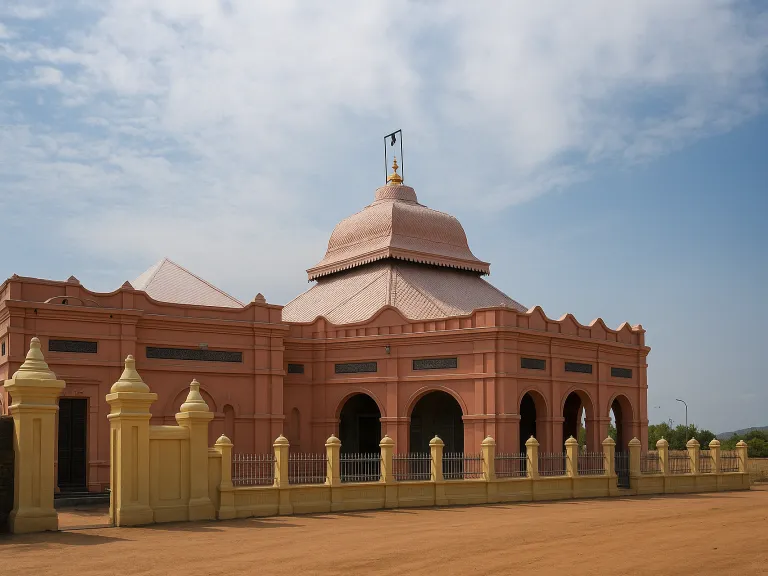
The architecture of Sathya Gnana Sabhai is deliberately different from that of a conventional South Indian temple. It does not centre on a garbhagriha containing a stone or metal idol, nor does it follow the usual pattern of tall gopurams, circumambulatory deity shrines, and Agamic ritual spaces. Its design serves Vallalar’s doctrine of worshipping the formless divine as light. The structure is therefore valued for its symbolic arrangement and restrained sacred purpose rather than for sculptural abundance.
The Sabhai is widely known for its octagonal form and for the sacred light placed within, screened by seven curtains. During Jyothi Darshan, these curtains are opened to reveal the light to devotees. The arrangement transforms architecture into spiritual instruction: the building, the veils, and the light together express the movement from outer perception to inner realization. The absence of anthropomorphic deity images reinforces Vallalar’s teaching that the divine is universal, subtle, and accessible through compassion and purity.
The surrounding sacred complex at Vadalur includes institutions connected with Vallalar’s mission, especially the Dharma Salai. The Sabhai’s architectural identity cannot be separated from this broader setting of worship and service. Its simplicity, non-idolatrous focus, and symbolic use of light make it an exceptional nineteenth-century Tamil spiritual monument. It stands outside dynastic temple traditions while remaining deeply rooted in Tamil devotional culture, ethical reform, and the lived practice of Sanmarga.
✨
Temple Highlights
✨
Arutperumjothi Worship
The Sabhai is dedicated to the contemplation of Arutperumjothi, the Supreme Grace-Light, without the use of a conventional idol.
✨
Seven-Curtain Jyothi Darshan
The sacred light is revealed after the opening of seven curtains, symbolizing the removal of veils that obstruct true spiritual knowledge.
✨
Founded by Vallalar
The shrine was established in 1872 by Ramalinga Swamigal, whose teachings emphasized compassion to all beings and universal spiritual realization.
✨
Linked with Sathya Dharma Salai
The Sabhai is part of Vallalar’s Vadalur mission, which also includes the Dharma Salai founded for feeding the hungry without discrimination.
✨
Non-Sectarian Spiritual Centre
The shrine is not organized around caste, dynastic patronage, or sectarian deity worship, but around light, compassion, and Sanmarga principles.
🙏
Spiritual Benefits
Inspiration to cultivate compassion toward all living beings
Contemplation of the divine as universal light
Encouragement to overcome ego, ignorance, and narrow social divisions
Deepening of devotion to Arutperumjothi
Reflection on the spiritual value of feeding the hungry
Motivation to follow non-violence and vegetarian discipline
Inner focus through silent prayer and light worship
🎉
Major Festivals
🎉
Thai Poosam Jyothi Darshan
The most important annual observance at Sathya Gnana Sabhai. Devotees gather at Vadalur for the sacred revelation of Arutperumjothi.
🎉
Monthly Poosam Jyothi Darshan
Poosam star days are significant for devotees, with Jyothi Darshan associated with the worship of Arutperumjothi.
🎉
Vallalar Remembrance Observances
Followers of Vallalar observe occasions connected with his life, teachings, and Sanmarga mission at Vadalur and related sites.
🪔
Special Poojas
🪔
Jyothi Darshan
The central form of worship at the Sabhai, focused on the revelation and contemplation of Arutperumjothi rather than idol-based ritual.
🪔
Arutperumjothi Prayer and Chanting
Devotional recitation of Vallalar’s Arutperumjothi invocation and hymns is an important part of worship associated with the Sabhai.
🚗
How to Reach
🛣️
By Road
Vadalur is in Cuddalore district and is connected by road to Cuddalore, Chidambaram, Neyveli, and Vriddhachalam. Buses and taxis are commonly used to reach the Sabhai.
🚆
By Rail
Vadalur has a railway station. Travellers may also use larger railheads in the Cuddalore, Chidambaram, or Vriddhachalam region depending on train availability.
✈️
By Air
The nearest regional air connectivity is through Puducherry. Chennai and Tiruchirappalli are larger airports used by many travellers to reach Cuddalore district.
💡
Visitor Tips
Verify current Jyothi Darshan schedules with the temple administration before travel.
Expect large crowds at Vadalur during Thai Poosam.
Understand that the Sabhai is not a conventional idol temple before visiting.
Maintain silence and decorum during Jyothi Darshan and prayer.
Combine the visit with Sathya Dharma Salai, which is historically connected with Vallalar’s mission.
Visitors interested in Vallalar’s final years may also learn about Siddhi Valagam at Mettukuppam.
Carry drinking water and plan transport in advance during festival days.

 WhatsApp Us