🛕About Temple
Sri Ramanasramam, commonly called Ramana Ashram, is a renowned spiritual ashram at the southern foot of Arunachala Hill in Tiruvannamalai, Tamil Nadu. It is associated with Bhagavan Sri Ramana Maharshi, one of modern India’s most influential sages, whose teaching centered on self-enquiry, inner stillness, and the direct investigation of the question “Who am I?”. The ashram is not a conventional dynastic temple complex, but it contains important shrines, samadhis, meditation halls, and places connected with Ramana Maharshi’s life.
The main sacred spaces include the Samadhi Shrine of Bhagavan Sri Ramana Maharshi, where the linga Sri Ramaneswara Mahalingam is worshipped, and the Matrubhuteswara Temple, built over the samadhi of his mother, Alagammal. The Old Hall, where Ramana Maharshi spent many years receiving devotees in silence, remains one of the most revered meditation spaces in the ashram. The campus also preserves the atmosphere of quiet discipline for which the ashram is known.
Situated close to the ancient Arunachaleswarar Temple and the path of Arunachala Girivalam, Sri Ramanasramam is visited by seekers from India and abroad. Its significance lies in the lived presence, teachings, and samadhi of Ramana Maharshi rather than in royal patronage or sectarian identity. The ashram continues to support meditation, Veda parayana, devotional singing, worship at the shrines, publication of Ramana’s works, and service to sincere visitors seeking spiritual reflection.
ℹ️Temple Information
🛕
Presiding Deity
Sri Ramaneswara Mahalingam
⭐
Temple Type
Ashram, Samadhi shrine, Shiva shrine, Meditation centre
📅
Built Period
Sri Ramanasramam took shape at the present site from 1922. The Matrubhuteswara Temple was consecrated in 1949, and Bhagavan Sri Ramana Maharshi’s Samadhi Shrine was established after his mahasamadhi in 1950.
Need Help Planning your visit to
Sri Ramana Ashram?
Our travel experts can help you with transportation,
darshan timings, nearby sightseeing and complete temple tour planning.
⭐Temple Significance
Sri Ramanasramam is significant as the final residence and samadhi place of Bhagavan Sri Ramana Maharshi, a major spiritual teacher of the twentieth century. It is a center for meditation, self-enquiry, Veda parayana, devotional worship, and study of Ramana Maharshi’s teachings, located at the sacred foot of Arunachala Hill.
📜History
The historical origin of Sri Ramanasramam is directly connected with the life of Venkataraman Iyer, later known as Bhagavan Sri Ramana Maharshi. Born in 1879 at Tiruchuzhi, he came to Tiruvannamalai in 1896 after a profound spiritual awakening. He first stayed in and around the Arunachaleswarar Temple and later lived in several places on Arunachala Hill, including Virupaksha Cave and Skandashram. During these years, devotees gradually gathered around him, drawn by his silence, simplicity, and spiritual authority.
The ashram began to take shape after the passing of Ramana Maharshi’s mother, Alagammal, in 1922. Her body was interred at the foot of Arunachala, and Ramana Maharshi moved down from Skandashram to remain near her samadhi. This move marked the beginning of the settled ashram at its present location. Over time, huts, kitchens, halls, and shrines were built to accommodate devotees and the growing daily routine around Bhagavan.
A major development was the construction of the Matrubhuteswara Temple over Alagammal’s samadhi, consecrated in 1949 during Ramana Maharshi’s lifetime. After Bhagavan’s mahasamadhi on 14 April 1950, his body was interred in the ashram and the Samadhi Shrine became the central place of worship. The administration and development of the ashram were significantly shaped by his brother, Niranjanananda Swami, known as Chinnaswami, and later by the Sri Ramanasramam trust, which continues to preserve the site and its traditions.
🕉️Mythology
The mythology connected with Ramana Ashram belongs primarily to Arunachala, the sacred hill at whose foot the ashram stands. In Shaiva mythology, Arunachala is revered as the fiery form of Shiva. The well-known Arunachala legend describes Shiva appearing as an infinite column of fire before Brahma and Vishnu, who could not find its beginning or end. This sacred fire was later manifested as Arunachala Hill for the benefit of devotees.
The annual Karthigai Deepam festival at Tiruvannamalai is linked with this mythology of the divine flame. A great beacon is lit on the summit of Arunachala, symbolizing Shiva as the boundless light of consciousness. The mythology is centered at the Arunachaleswarar Temple, but it also forms the sacred landscape in which Sri Ramanasramam exists. For devotees of Ramana Maharshi, Arunachala is not merely a hill near the ashram; it is the spiritual presence that drew him to Tiruvannamalai and shaped his life.
Ramana Maharshi himself expressed deep devotion to Arunachala in hymns such as Aksharamanamalai and other compositions. These works speak of Arunachala as the inner Self and as the power that destroys ego and grants liberation. This devotional and contemplative understanding connects the ashram to the older sacred mythology of Tiruvannamalai while keeping a clear distinction between the historical life of Ramana Maharshi and the mythic identity of Arunachala.
🏛Architecture
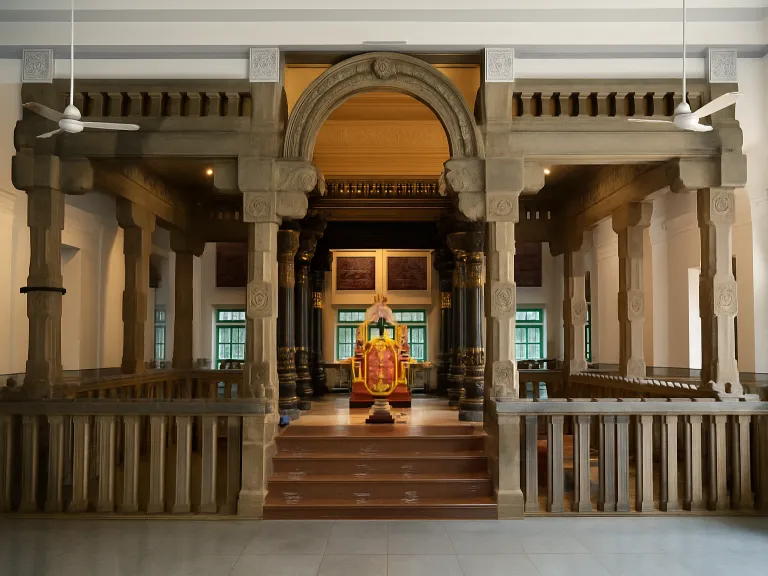
Sri Ramanasramam has an architectural character shaped by both traditional South Indian sacred design and the functional simplicity of an ashram. The campus is arranged at the base of Arunachala Hill with shrines, meditation halls, residential areas, dining facilities, publication offices, and spaces for daily worship. Unlike large medieval temple complexes, its layout developed gradually according to the needs of the ashram community and the growing number of devotees.
The Matrubhuteswara Temple is the most temple-like structure within the ashram. Built over the samadhi of Alagammal, it follows South Indian Shaiva temple features, with a sanctum for the Matrubhuteswara linga, a vimana, mandapas, sculptural details, and a sacred inner atmosphere. The shrine is also associated with Sri Chakra worship. Its consecration in 1949 made it one of the major sacred centers of the ashram during Bhagavan Ramana Maharshi’s own lifetime.
The Samadhi Shrine of Bhagavan Sri Ramana Maharshi is architecturally simpler but deeply significant. It houses the linga known as Sri Ramaneswara Mahalingam above his samadhi and serves as the focal point for worship and meditation. The Old Hall, preserved as a quiet meditation space, reflects the austerity of Ramana’s life: plain, intimate, and free from ornamentation. The New Hall, dining hall, book depot, and other buildings complete the ashram’s lived spiritual environment rather than functioning as royal or dynastic monuments.
✨
Temple Highlights
✨
Samadhi Shrine of Bhagavan Sri Ramana Maharshi
The central shrine of the ashram houses Sri Ramaneswara Mahalingam over the samadhi of Bhagavan Sri Ramana Maharshi, who attained mahasamadhi on 14 April 1950.
✨
Matrubhuteswara Temple
This temple was built over the samadhi of Alagammal, the mother of Ramana Maharshi, and was consecrated in 1949 during Bhagavan’s lifetime.
✨
Old Hall
The Old Hall is the simple meditation hall where Ramana Maharshi sat for many years and received devotees, often in silence.
✨
Arunachala Setting
The ashram stands at the foot of Arunachala Hill, the sacred mountain central to Ramana Maharshi’s life and teachings.
✨
Veda Parayana and Devotional Routine
The ashram maintains daily recitation, worship, meditation, and devotional practices centered on the shrines and the teachings of Ramana Maharshi.
🙏
Spiritual Benefits
Supports the practice of self-enquiry taught by Bhagavan Sri Ramana Maharshi
Encourages inner silence and meditative awareness
Provides a sacred environment for contemplation at the foot of Arunachala
Helps devotees study the life and teachings of Ramana Maharshi
Offers participation in Veda parayana and devotional worship
Inspires detachment, simplicity, and inwardness
Connects seekers with the Arunachala spiritual tradition
🎉
Major Festivals
🎉
Ramana Jayanti
Ramana Jayanti commemorates the birth anniversary of Bhagavan Sri Ramana Maharshi and is observed at the ashram with worship, recitation, and devotional activities.
🎉
Bhagavan Sri Ramana Maharshi Aradhana
The Aradhana marks the mahasamadhi day of Bhagavan Sri Ramana Maharshi on 14 April 1950 and is one of the most important annual observances at Sri Ramanasramam.
🎉
Mother Alagammal Aradhana
This observance honors Alagammal, the mother of Ramana Maharshi, whose samadhi is enshrined in the Matrubhuteswara Temple.
🎉
Karthigai Deepam
Karthigai Deepam is the major Arunachala festival of Tiruvannamalai. The ashram receives many visitors during this period because of its location at the foot of the sacred hill.
🎉
Navaratri
Navaratri is observed in connection with the goddess worship associated with the Matrubhuteswara Temple and Sri Chakra worship at the ashram.
🪔
Special Poojas
🪔
Daily worship at Sri Ramaneswara Mahalingam
Regular worship is performed at the Samadhi Shrine of Bhagavan Sri Ramana Maharshi, where Sri Ramaneswara Mahalingam is installed.
🪔
Daily worship at Matrubhuteswara Temple
Worship is offered at the Matrubhuteswara Temple, the shrine built over the samadhi of Alagammal.
🪔
Sri Chakra Puja
Sri Chakra worship is associated with the Matrubhuteswara Temple and is an important ritual observance at Sri Ramanasramam.
🪔
Veda Parayana
Vedic recitation forms a regular part of the ashram’s spiritual routine and is closely associated with its shrine worship and meditative atmosphere.
🚗
How to Reach
🛣️
By Road
Tiruvannamalai is well connected by road with Chennai, Bengaluru, Puducherry, Vellore, Salem, and other towns in Tamil Nadu. Sri Ramanasramam is located on the Chengam Road side of Tiruvannamalai at the foot of Arunachala.
🚆
By Rail
The nearest railway station is Tiruvannamalai Railway Station, which has rail connections to regional destinations. From the station, visitors can reach the ashram by local transport.
✈️
By Air
The nearest airport is Puducherry Airport, while Chennai International Airport is a major airport used by many visitors traveling to Tiruvannamalai.
💡
Visitor Tips
Maintain silence in meditation areas and shrine spaces.
Check the current ashram schedule before visiting, as timings and events may change.
Dress modestly and behave respectfully inside the campus.
Allow time for quiet meditation in the Old Hall and Samadhi Shrine.
Read about Ramana Maharshi’s life and teachings before visiting for better context.
During full-moon Girivalam and Karthigai Deepam, expect heavy crowds in Tiruvannamalai.
Follow all instructions displayed by the ashram administration.
Do not disturb residents, monks, or visitors engaged in prayer or meditation.

 WhatsApp Us