🛕About Temple
Saint Thyagaraja Temple at Thiruvaiyaru is the revered samadhi shrine of Sri Tyagaraja, the eighteenth–nineteenth century Carnatic composer and Rama devotee who is honored as one of the Trinity of Carnatic music. The shrine stands in Thiruvaiyaru, a historic town on the banks of the Kaveri in present-day Thanjavur district, Tamil Nadu. It is not an ancient dynastic temple in the usual sense, but a sacred memorial built around the place where the saint’s mortal remains were interred in 1847.
The temple is a major pilgrimage centre for musicians, students of music, devotees of Sri Rama, and admirers of Tyagaraja’s compositions. The saint’s kritis, composed largely in Telugu and dedicated especially to Rama, shaped the devotional and musical vocabulary of South Indian classical music. Visitors come here to offer respects at the samadhi, to remember his life of bhakti, and to experience the continuing link between worship and music.
The shrine is best known worldwide for the annual Tyagaraja Aradhana, held on Pushya Bahula Panchami, the saint’s day of samadhi. During this observance, musicians assemble at Thiruvaiyaru and render the Pancharatna Kritis in unison before the shrine. The event has made the temple a living cultural space where devotion, memory, and the guru-shishya tradition of Carnatic music remain closely connected.
ℹ️Temple Information
🛕
Presiding Deity
Saint Tyagaraja
⭐
Temple Type
Samadhi shrine, Saint memorial, Carnatic music pilgrimage site, Rama bhakti shrine
📅
Built Period
Samadhi established in 1847 CE; present shrine developed in the early 20th century CE.
🏛
Dynasty
Not applicable; the present shrine is a modern samadhi memorial, not a dynastic temple.
Need Help Planning your visit to
Saint Thyagaraja Temple?
Our travel experts can help you with transportation,
darshan timings, nearby sightseeing and complete temple tour planning.
⭐Temple Significance
The shrine is the samadhi of Saint Tyagaraja, one of the Trinity of Carnatic music and a foremost composer-saint devoted to Sri Rama. It is the central venue of the annual Tyagaraja Aradhana, where musicians render the Pancharatna Kritis in collective homage.
📜History
Sri Tyagaraja was born in 1767 at Tiruvarur and later lived for most of his life at Thiruvaiyaru, where he composed many of his celebrated kritis in praise of Sri Rama. He belonged to a family of Telugu-speaking scholars and musicians, and his life is remembered for intense devotion, musical discipline, and refusal to use music primarily for royal patronage. His works became central to the modern Carnatic repertoire and are preserved through several disciple lineages.
Tyagaraja attained samadhi at Thiruvaiyaru in 1847, on Pushya Bahula Panchami. His mortal remains were interred on the banks of the Kaveri, and his disciples observed annual remembrance rituals. Over time, the observances were carried on by different groups of disciples and musicians. The site later came to be formally developed into a shrine, turning the samadhi into a permanent place of worship and remembrance.
A major role in the preservation of the site was played by Bengaluru Nagarathnamma, the noted musician and patron. In the early twentieth century she acquired and restored the samadhi area, built the shrine, and worked to make the annual aradhana more organized and inclusive. Her contribution is central to the history of the present temple. The Tyagabrahma Mahotsava Sabha later became associated with the conduct of the annual festival, which continues to draw musicians and devotees from across India and abroad.
🕉️Mythology
Saint Thyagaraja Temple is primarily a historical samadhi shrine, and it does not have a temple-sthala purana comparable to ancient Shaiva or Vaishnava temples. Its sacred narratives arise from the devotional memory of Tyagaraja’s life, his worship of Sri Rama, and the hagiographical accounts preserved by musicians, disciples, and devotees. These narratives belong to the sphere of bhakti tradition rather than political or architectural history.
In devotional accounts, Tyagaraja is remembered as a saint who saw music as a direct path to Rama bhakti. Stories connected with his life describe his refusal of worldly rewards, his dedication to nama-sankirtana, and his deep emotional relationship with the image of Sri Rama he worshipped. These accounts are not treated as dynastic history; they express how later generations understood the spiritual force behind his compositions.
The most powerful living sacred tradition of the shrine is the annual collective singing of the Pancharatna Kritis during the Tyagaraja Aradhana. Devotees regard this musical offering as an act of worship to the saint and through him to Sri Rama. The gathering affirms the belief that Tyagaraja’s music is not merely artistic literature but a vehicle of devotion, surrender, and spiritual refinement. Thus, the temple’s mythology is best understood as a devotional memory centered on Rama bhakti and the sanctity of music.
🏛Architecture
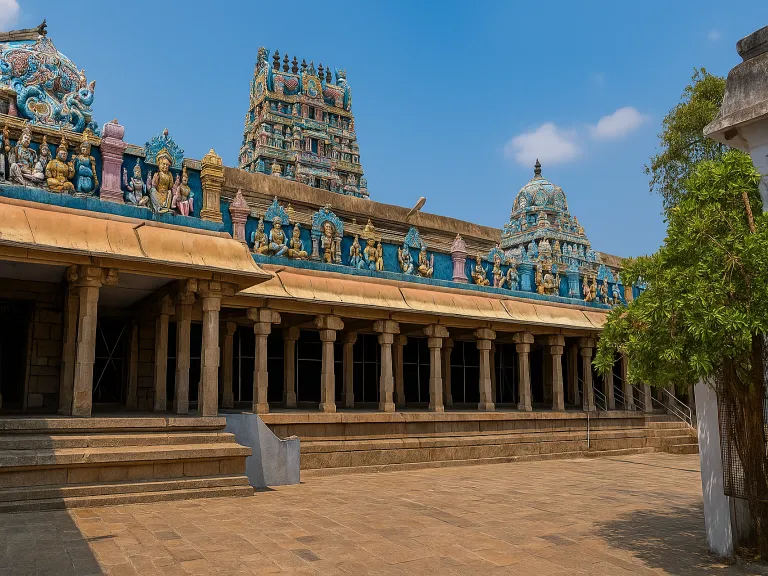
The Saint Thyagaraja Temple at Thiruvaiyaru is a modern samadhi shrine rather than a large medieval stone temple built by a royal dynasty. Its architecture is therefore modest and devotional in character. The focus of the complex is the samadhi of Sri Tyagaraja, which is treated as the sanctified centre of worship. The shrine developed in the early twentieth century around the earlier burial place on the Kaveri bank.
The temple contains a sanctum-like memorial space for the saint, where devotees offer worship and pay respects. The layout supports both ritual reverence and musical homage. During the annual Tyagaraja Aradhana, the open areas and temporary festival arrangements around the shrine become important performance and congregation spaces. The architecture is closely tied to the function of the site: remembrance, devotional singing, and collective homage by the Carnatic music community.
Unlike ancient South Indian temples with multiple prakaras, tall gopurams, elaborate iconographic programs, and inscriptions from successive dynasties, this shrine is valued for its association with the saint and the continuity of the aradhana tradition. The simplicity of the structure strengthens the focus on the samadhi, the memory of Tyagaraja, and the musical offering made in his honor. Its cultural importance lies less in monumental scale and more in its role as a living memorial of Carnatic music and Rama bhakti.
✨
Temple Highlights
✨
Samadhi of Saint Tyagaraja
The temple marks the sacred resting place of Sri Tyagaraja, the celebrated Carnatic composer and Rama devotee who attained samadhi at Thiruvaiyaru in 1847.
✨
Tyagaraja Aradhana
The annual aradhana is the shrine’s most prominent observance, drawing musicians and devotees who gather to pay homage through music and worship.
✨
Pancharatna Kriti Rendering
During the aradhana, musicians sing Tyagaraja’s five great Pancharatna Kritis together before the shrine, creating one of the most recognized events in Carnatic music.
✨
Association with Bengaluru Nagarathnamma
The preservation and development of the shrine are closely associated with Bengaluru Nagarathnamma, whose work ensured the continued dignity of the samadhi site.
✨
Kaveri Bank Location
The shrine stands at Thiruvaiyaru on the banks of the Kaveri, a town historically associated with Tyagaraja’s life and compositions.
🙏
Spiritual Benefits
Inspiration for devotion to Sri Rama
Reverence for the guru-shishya tradition of Carnatic music
Spiritual reflection through the saint’s compositions
Cultivation of humility and surrender through bhakti
Blessings sought by musicians and music students
Connection with the Pancharatna Kriti tradition
Remembrance of a saintly life dedicated to music and devotion
🎉
Major Festivals
🎉
Tyagaraja Aradhana
The principal annual festival of the shrine, observed on Pushya Bahula Panchami, commemorates the day Saint Tyagaraja attained samadhi. Musicians gather at Thiruvaiyaru and offer homage through worship and collective singing.
🎉
Pancharatna Kriti Group Rendering
A central feature of the Tyagaraja Aradhana, this musical homage brings together Carnatic musicians who render the five Pancharatna Kritis in unison before the samadhi.
🪔
Special Poojas
🪔
Samadhi Aradhana
The most important special observance at the shrine is the annual aradhana at the samadhi of Saint Tyagaraja on Pushya Bahula Panchami.
🚗
How to Reach
🛣️
By Road
Thiruvaiyaru is connected by road to Thanjavur, which is about 13 km away. Buses, taxis, and local transport operate between Thanjavur and Thiruvaiyaru.
🚆
By Rail
The nearest major railway station is Thanjavur Junction. From Thanjavur, visitors can reach Thiruvaiyaru by road.
✈️
By Air
The nearest major airport is Tiruchirappalli International Airport. From the airport, visitors can travel by road via Thanjavur to Thiruvaiyaru.
💡
Visitor Tips
Confirm current opening hours locally before planning a visit, especially outside festival days.
Expect very large crowds during the annual Tyagaraja Aradhana in January or February.
Maintain silence and decorum near the samadhi, particularly during worship and musical offerings.
Do not take photographs inside the shrine unless permission is clearly given by the temple authorities.
Plan additional time if visiting during the aradhana, as traffic and parking in Thiruvaiyaru can be crowded.
Thanjavur is the nearest major transport base for rail connections and accommodation.
Combine the visit with nearby historic temples in Thiruvaiyaru and the surrounding Kaveri region if time permits.

 WhatsApp Us