🛕About Temple
Kasthuri Ranganatha Perumal Temple is a revered Vishnu temple in Erode, Tamil Nadu, located within the old urban core of the city. The presiding deity is Sri Kasthuri Ranganatha Perumal, a form of Vishnu worshipped in the reclining posture on Adisesha. The temple is an important Vaishnava shrine for devotees in Erode and the surrounding Kongu region, and it remains closely associated with the city’s historic temple landscape.
The temple’s identity is centred on the Ranganatha form, the same theological form made famous by major South Indian Vaishnava temples where Vishnu is seen as the supreme protector resting on the cosmic serpent. The goddess is worshipped as Kamalavalli Thayar. Devotees visit the shrine for darshan of the reclining Perumal, for prayers connected with family welfare, mental peace, prosperity and spiritual discipline, and during important Vishnu festivals.
Unlike some larger temple centres, the publicly available historical record for this temple does not provide a securely established founder, exact construction date or complete inscriptional chronology. For that reason, details such as the builder, dynasty and Agamic affiliation are best treated cautiously unless confirmed from temple records. The temple’s significance is nevertheless well established locally through continuous worship, its location in Erode, and its role as one of the notable Vaishnava places of worship in the district.
ℹ️Temple Information
🛕
Presiding Deity
Sri Kasthuri Ranganatha Perumal
👸
Goddess
Sri Kamalavalli Thayar
⭐
Temple Type
Vishnu temple, Perumal temple, Vaishnava temple, Ranganatha temple
Need Help Planning your visit to
Arulmigu Kasthuri Ranganatha Perumal Temple?
Our travel experts can help you with transportation,
darshan timings, nearby sightseeing and complete temple tour planning.
⭐Temple Significance
The temple is significant as an important Vishnu shrine in Erode dedicated to Sri Kasthuri Ranganatha Perumal in the reclining Ranganatha form, with Kamalavalli Thayar as the goddess. Its importance rests on continuous worship, local devotion and its place in the Vaishnava sacred landscape of the Kongu region.
📜History
The historical profile of Kasthuri Ranganatha Perumal Temple is connected with the religious history of Erode, a town that formed part of the Kongu region of Tamil Nadu. Erode’s temple traditions developed under several political phases, including medieval Tamil powers and later regional administrations. However, a reliable, widely published record identifying the original builder of this specific temple or assigning it to a confirmed dynasty is not available in standard public temple summaries.
Because of this limitation, the temple should not be presented as the work of a particular king or ruling house without direct inscriptional or archival proof. Its importance is better understood through its continued presence in the old part of Erode and through its role in sustaining Vaishnava worship in the city. The shrine’s main deity, Kasthuri Ranganatha Perumal, reflects the strong South Indian devotion to Vishnu as Ranganatha, a form that has been worshipped across Tamil Nadu for many centuries.
The temple has remained a living place of worship rather than a monument known primarily through royal inscriptions. Daily and festival worship, local devotional memory, and the presence of the reclining Vishnu image form the core of its historical continuity. Until authenticated epigraphical details are published or verified from temple records, fields such as construction century, patron king and dynasty should remain unspecified. This cautious approach preserves the distinction between established history and later devotional or local traditions.
🕉️Mythology
The mythology associated with Kasthuri Ranganatha Perumal Temple is centred on the Vaishnava understanding of Lord Vishnu as Ranganatha, the divine form reclining on Adisesha, the serpent of cosmic time. In this iconography, Vishnu rests in yogic serenity while sustaining the universe. The form represents protection, order, compassion and the promise that divine grace remains present even when the world passes through change and uncertainty.
The name Ranganatha connects the deity with the broader South Indian sacred imagination in which Vishnu is the lord of the divine stage or sacred space. The reclining posture is associated with the cosmic ocean, Adisesha, Goddess Lakshmi’s grace, and the preservation of dharma. The temple’s epithet “Kasthuri” is connected linguistically with musk, a sacred and auspicious fragrance used in temple worship, though a specific, securely documented local legend explaining the name is not available from widely established sources.
No detailed Sthala Purana for this temple is widely documented in reliable public sources. Therefore, the mythology should be described through the broader and well-established Vaishnava symbolism of Ranganatha rather than through unverified local episodes. Devotees approach the deity as the compassionate reclining Perumal who grants protection, steadiness of mind, household harmony and spiritual progress. The goddess Kamalavalli Thayar is worshipped as the merciful divine mother whose presence completes the temple’s Vishnu-centred devotional tradition.
🏛Architecture
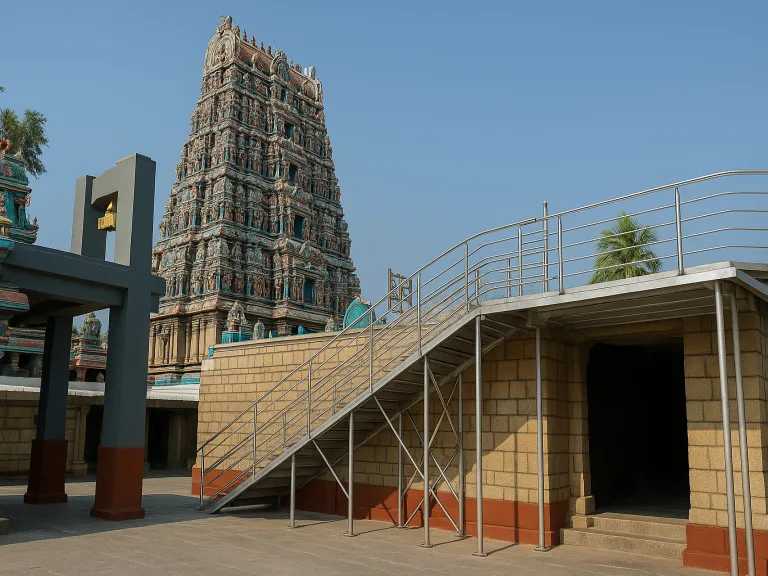
Kasthuri Ranganatha Perumal Temple follows the broad pattern of a Tamil Vaishnava temple, with worship focused on a sanctum that enshrines Sri Kasthuri Ranganatha Perumal in the reclining form. The image of Vishnu resting on Adisesha is the principal architectural and devotional focus of the shrine. The layout supports circumambulation, ritual worship and festival movement within the temple precinct, as is characteristic of South Indian temple practice.
The temple includes the essential components expected in a traditional Vishnu shrine: the sanctum for the moolavar, spaces for devotees to gather for darshan, and a separate shrine for the goddess Kamalavalli Thayar. The built form belongs to the Dravidian temple idiom of Tamil Nadu, where the sanctum, mandapa spaces, stucco or sculptural deity forms, and ritual axes together create a sacred environment. Publicly verified details about the original construction phase, master builders or dated sculptural programme are not available.
The architectural significance of the temple lies less in a published royal building record and more in the way it preserves the ritual grammar of a Vaishnava shrine within Erode’s urban setting. The reclining Perumal image gives the temple its distinctive identity. Visitors should understand the structure as a living temple where architecture functions primarily in the service of worship, procession, offerings and community devotion. Any claims about exact period, dynasty-specific style or original patronage should be confirmed from inscriptions or temple records before being treated as historical fact.
✨
Temple Highlights
✨
Reclining Ranganatha Darshan
The main deity, Sri Kasthuri Ranganatha Perumal, is worshipped as Vishnu reclining on Adisesha, a deeply revered iconographic form in South Indian Vaishnavism.
✨
Kamalavalli Thayar Shrine
The goddess is worshipped as Kamalavalli Thayar, representing divine compassion and grace within the temple’s Vaishnava tradition.
✨
Historic Erode Location
The temple stands within Erode city and forms part of the city’s long-standing Hindu temple landscape.
✨
Vaishnava Worship Tradition
The shrine is associated with devotional worship of Vishnu through darshan, archana, offerings and festival observances.
✨
Living Temple Culture
The temple continues as an active place of worship for local devotees rather than only as a historical monument.
🙏
Spiritual Benefits
Blessings of Lord Vishnu for protection and wellbeing
Mental peace through darshan of the reclining Perumal
Prayers for harmony in family life
Devotion to Kamalavalli Thayar for compassion and grace
Spiritual discipline through regular worship and remembrance of Vishnu
Prayers for prosperity and stability
Support for Vaishnava devotional practices such as archana and festival worship
🎉
Major Festivals
🎉
Vaikunta Ekadasi
Vaikunta Ekadasi is one of the most important festival days for Vishnu temples, marked by special worship and large devotee participation.
🎉
Purattasi Saturdays
Saturdays in the Tamil month of Purattasi are especially associated with worship of Lord Vishnu and draw devotees to Perumal temples.
🎉
Krishna Jayanthi
Krishna Jayanthi, celebrating the birth of Lord Krishna, is an important Vaishnava observance connected with Vishnu worship.
🪔
Special Poojas
🪔
Archana
Devotees commonly offer archana to Sri Kasthuri Ranganatha Perumal and Kamalavalli Thayar; availability should be confirmed at the temple.
🪔
Thirumanjanam
Ceremonial abhishekam or thirumanjanam is part of Vaishnava temple worship; specific dates and participation details should be confirmed with the temple.
🪔
Vaikunta Ekadasi Special Worship
Special worship is associated with Vaikunta Ekadasi in Vishnu temples; visitors should verify the temple’s arrangements and timings in advance.
🚗
How to Reach
🛣️
By Road
Erode is well connected by road to Coimbatore, Salem, Tiruppur, Karur and Bhavani. Local buses, taxis and auto-rickshaws provide access within the city.
🚆
By Rail
Erode Junction is a major railway station on important South Indian rail routes and is the nearest major railhead for the temple.
✈️
By Air
The nearest major airport is Coimbatore International Airport. From the airport, travellers can reach Erode by road or rail connections.
💡
Visitor Tips
Confirm current opening hours with the temple before visiting.
Visit early in the day or during non-peak hours for a calmer darshan experience.
Wear modest clothing suitable for a Hindu temple.
Follow temple instructions regarding footwear, queues and offerings.
Do not photograph inside the shrine unless permission is clearly given.
Festival days may attract larger crowds, so plan extra time.
Carry cash for offerings if digital payment facilities are not available.
Respect ongoing rituals and avoid crossing restricted areas.

 WhatsApp Us