🛕About Temple
Meenakshi Amman Temple, also called Arulmigu Meenakshi Sundareswarar Temple, stands at the historic centre of Madurai in Tamil Nadu. The temple is dedicated to Goddess Meenakshi, a form of Parvati, and Lord Sundareswarar, a form of Shiva. It is one of the most celebrated living temples of South India and remains closely connected with the religious, cultural, and civic identity of Madurai.
The temple complex is arranged around the shrines of Meenakshi and Sundareswarar, with Meenakshi occupying a place of exceptional prominence. Its sacred tank, halls, corridors, towers, and festival routes form a major ritual landscape. The temple is especially associated with the Chithirai festival, during which the celestial wedding of Meenakshi and Sundareswarar is celebrated as a grand public event.
Historically, the shrine has roots in the Pandya country, while much of the present monumental complex reflects later rebuilding and expansion, especially under the Madurai Nayak rulers. The temple is known for its towering gopurams covered with painted stucco figures, its sculpted halls, and its uninterrupted ritual life. It is a major pilgrimage centre for devotees of Shiva and Shakti and a landmark monument of Tamil religious art.
ℹ️Temple Information
🛕
Presiding Deity
Sundareswarar
👸
Goddess
Meenakshi Amman
⭐
Temple Type
Shiva temple, Shakti temple, Dravidian temple, Paadal Petra Sthalam-associated Shaiva tradition, Living temple
📅
Built Period
Ancient sacred origins; major surviving architectural expansion mainly from the 16th to 17th centuries CE.
🏛
Dynasty
Pandya; Madurai Nayak
Need Help Planning your visit to
Arulmigu Meenakshi Amman Temple?
Our travel experts can help you with transportation,
darshan timings, nearby sightseeing and complete temple tour planning.
⭐Temple Significance
Meenakshi Amman Temple is one of the foremost Shiva-Shakti temples of South India and the principal sacred landmark of Madurai. It is significant for the worship of Meenakshi as the divine queen of the city, for the Meenakshi-Sundareswarar wedding festival, and for its Nayak-period Dravidian architecture.
📜History
Madurai is one of the ancient urban centres of Tamil Nadu, and the worship of Shiva and the goddess at this site is closely associated with the city’s early Pandya heritage. Literary and inscriptional traditions connect Madurai with the Pandya rulers, Tamil scholarship, and temple-centred civic life. The earliest shrine at the site is understood to be older than the present visible structures, but the exact date of the first construction is not historically fixed.
The temple suffered damage during the political upheavals that followed the invasion of the Madurai region in the early fourteenth century. Later, when regional Hindu rule was restored, the temple received renewed patronage. The Vijayanagara period and the Madurai Nayak period were especially important in reviving temple institutions, restoring worship, and expanding the architectural scale of the complex.
The present form of Meenakshi Amman Temple owes much to the Madurai Nayaks of the sixteenth and seventeenth centuries. Viswanatha Nayak and later Nayak rulers supported major additions, while Tirumala Nayak is remembered for significant architectural patronage in Madurai. The tall gateway towers, large mandapas, festival spaces, and sculptural programmes that define the temple today belong largely to this phase of expansion, though they stand upon an older sacred and historical foundation.
🕉️Mythology
According to the temple’s sacred mythology, King Malayadhwaja Pandya and Queen Kanchanamalai performed a sacrifice seeking a child. From the sacrificial fire emerged a princess with three breasts, named Tadaatakai. A divine voice declared that the third breast would disappear when she met her destined consort. She grew into a warrior queen and came to be revered as Meenakshi, the fish-eyed goddess of Madurai.
The mythology describes Meenakshi as a powerful ruler who conquered many regions and finally reached Mount Kailasa, where she encountered Shiva. At that moment her third breast disappeared, revealing her divine destiny. Shiva came to Madurai as Sundareswarar, the beautiful Lord, and married Meenakshi. This sacred wedding is the central mythic event celebrated every year during the Chithirai festival.
Another important legend connects the site with Indra, who sought relief from the sin of killing a demon. During his pilgrimage he found a self-manifested Shiva lingam beneath a Kadamba tree at Madurai and worshipped it with golden lotus flowers from the sacred tank. These myths explain the sacred geography of the temple, the sanctity of the Golden Lotus Tank, and the prominence of Meenakshi as queen and divine guardian of Madurai.
🏛Architecture
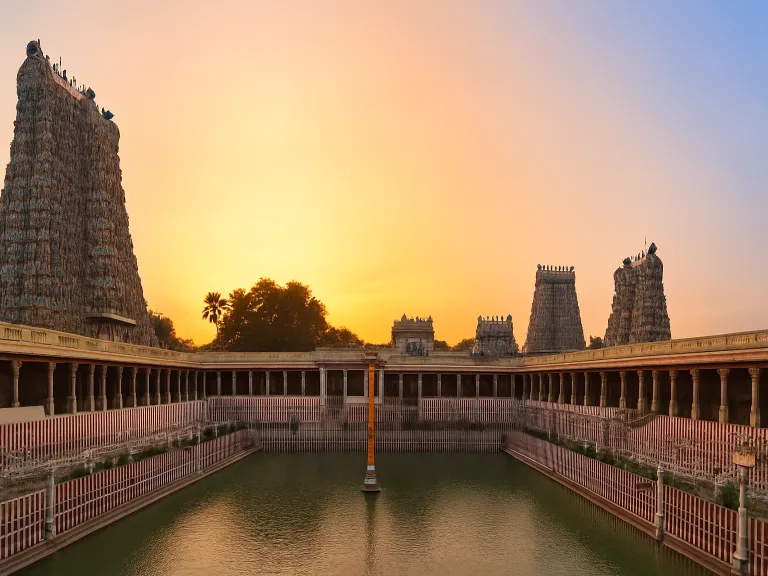
Meenakshi Amman Temple is one of the most elaborate examples of the Dravidian temple tradition in Tamil Nadu. The complex is enclosed by high walls and entered through monumental gopurams covered with dense rows of brightly painted stucco figures representing deities, guardians, celestial beings, animals, and mythological scenes. The temple has multiple towers, with the southern gopuram being among the tallest and most visually dominant.
The layout is centred on the twin sanctums of Meenakshi and Sundareswarar, supported by a series of concentric spaces, corridors, mandapas, and ritual pathways. The Porthamarai Kulam, or Golden Lotus Tank, is an important interior landmark. The thousand-pillared hall, known as Ayiram Kaal Mandapam, is celebrated for its sculptural arrangement and is associated with Nayak-period craftsmanship.
The architecture reflects both sacred function and royal patronage. Large mandapas were designed for ritual gatherings, processional images, music, dance, festival preparations, and public worship. Sculpted pillars depict deities, warriors, mythical animals, and donors. The temple’s visual language combines Shaiva, Shakti, and broader Tamil religious themes, making it a major monument of late medieval South Indian temple building.
🌳
Sacred Features
🌳 Temple Tree
Kadamba tree
The Kadamba tree is the temple’s sacred tree and is linked in the temple mythology with Indra discovering and worshipping the Shiva lingam at Madurai.
💧 Temple Tank
Porthamarai Kulam
Porthamarai Kulam, the Golden Lotus Tank, is the sacred tank inside the temple. It is associated with the legend of golden lotus flowers and with Madurai’s sacred and literary traditions.
✨
Temple Highlights
✨
Twin Shrines of Meenakshi and Sundareswarar
The temple is centred on the shrines of Goddess Meenakshi and Lord Sundareswarar, representing the sacred union of Shakti and Shiva in Madurai.
✨
Towering Dravidian Gopurams
The temple is renowned for its monumental gateway towers covered with thousands of colourful stucco images of deities, guardians, and mythological figures.
✨
Porthamarai Kulam
The Golden Lotus Tank is a sacred water body inside the temple and is linked with legends of Indra and the cultural memory of Madurai.
✨
Ayiram Kaal Mandapam
The thousand-pillared hall is a celebrated Nayak-period mandapa known for its sculptural richness and architectural rhythm.
✨
Chithirai Festival
The annual Chithirai festival celebrates the divine wedding of Meenakshi and Sundareswarar and is one of Tamil Nadu’s major temple festivals.
✨
Palliarai Ritual
The nightly ceremonial procession of Sundareswarar to the chamber of Meenakshi is an important daily ritual observed by devotees.
🙏
Spiritual Benefits
Devotees worship Meenakshi Amman for marital harmony and family welfare.
Devotees pray to Sundareswarar for inner strength and spiritual clarity.
The divine wedding of Meenakshi and Sundareswarar is associated with blessings for marriage.
Worship at the temple is sought for prosperity and well-being.
The sacred tank and temple rituals are associated with purification in devotional practice.
The temple is revered as a place for experiencing the grace of Shiva and Shakti together.
Devotees seek protection and guidance from Meenakshi as the guardian goddess of Madurai.
🎉
Major Festivals
🎉
Chithirai Thiruvizha
The grand annual festival of Madurai, centred on the coronation and celestial wedding of Meenakshi with Sundareswarar. It draws large crowds and includes major processions.
🎉
Meenakshi Tirukalyanam
The sacred wedding ceremony of Meenakshi and Sundareswarar, celebrated as the central ritual event of the Chithirai festival.
🎉
Navaratri
A major festival for the goddess, marked by special worship, decoration, and devotional observances for Meenakshi Amman.
🎉
Avani Moola Festival
A Shaiva festival associated with the divine acts of Lord Sundareswarar in Madurai, celebrated with temple rituals and processions.
🎉
Thai Float Festival
The float festival associated with Madurai temple traditions is celebrated in the Tamil month of Thai, with processional deities taken in a decorated float at the Teppakulam.
🪔
Special Poojas
🪔
Thiruvanandal Pooja
Early morning worship performed as part of the temple’s daily ritual sequence.
🪔
Vizha Pooja
A daily worship service offered to the deities according to the temple’s established ritual schedule.
🪔
Kalasandhi Pooja
Morning worship performed after the temple opens and daily rituals begin.
🪔
Uchikala Pooja
Midday worship offered before the temple closes for the afternoon interval.
🪔
Sayaraksha Pooja
Evening worship performed after the temple reopens for the evening session.
🪔
Palliarai Pooja
Night ritual in which Sundareswarar is ceremonially taken to the chamber of Meenakshi before the temple closes.
🚗
How to Reach
🛣️
By Road
Madurai is well connected by road with major cities of Tamil Nadu and neighbouring states. The temple is located in central Madurai and can be reached by city buses, taxis, and auto-rickshaws.
🚆
By Rail
Madurai Junction is the nearest major railway station and has train connections to Chennai, Bengaluru, Coimbatore, Tiruchirappalli, Rameswaram, and other cities.
✈️
By Air
Madurai Airport serves domestic flights and is the nearest airport to the temple. Taxis and buses connect the airport with the city.
💡
Visitor Tips
Carry a valid identity document if required for security checks.
Avoid carrying cameras or items restricted by temple security rules.
Dress modestly and be prepared to remove footwear before entering the temple precincts.
Expect heavy crowds during Chithirai festival, Fridays, weekends, and major Hindu festival days.
Use official counters or temple-authorized services for darshan and offerings.
Check current temple timings and regulations before visiting, as they may change during festivals.
Maintain silence and follow queue discipline inside the sanctum areas.
Allow sufficient time to see the gopurams, Golden Lotus Tank, main shrines, and mandapas.

 WhatsApp Us