🛕About Temple
Vandiyur Mariamman Teppakulam is the large sacred tank at Vandiyur in Madurai, Tamil Nadu, and is one of the best-known ritual water monuments of the city. The word “teppakulam” means a float tank, and the site is famous as the venue of the annual float festival connected with the Meenakshi Sundareswarar Temple. It lies to the east of Madurai’s old temple-centred core and takes its name from the nearby Vandiyur Mariamman Temple.
The Teppakulam is historically associated with King Thirumalai Nayak of the Madurai Nayak dynasty. Its scale, stone-lined steps, central island pavilion and ritual use make it more than a utilitarian water body. It functions as a ceremonial extension of Madurai’s sacred geography, linking the city’s royal Nayak past with the worship of Meenakshi, Sundareswarar, Mariamman and Vinayakar.
During the annual Theppotsavam, processional images of Goddess Meenakshi and Lord Sundareswarar are brought from the Meenakshi Amman Temple and placed on a decorated float that moves around the tank. The event draws large gatherings and is among the most visually distinctive festivals of Madurai. Outside festival days, the tank is valued for its historic setting, broad stepped edges, central mandapam and its association with Thirumalai Nayak’s urban works.
ℹ️Temple Information
🛕
Presiding Deity
Vinayakar
👸
Goddess
Vandiyur Mariamman
⭐
Temple Type
Temple tank, Theppakulam, Festival venue, Mariamman-associated sacred site
📅
Built Period
1645 CE, 17th century
🏛
Dynasty
Madurai Nayak dynasty
Need Help Planning your visit to
Vandiyur Mariamman Teppakulam?
Our travel experts can help you with transportation,
darshan timings, nearby sightseeing and complete temple tour planning.
⭐Temple Significance
Vandiyur Mariamman Teppakulam is significant as a 17th-century Nayak-period sacred tank and as the venue of Madurai’s celebrated Meenakshi Sundareswarar Float Festival. It connects the royal building activity of Thirumalai Nayak with the living ritual traditions of the Meenakshi Amman Temple and the devotional identity of Vandiyur Mariamman.
📜History
Vandiyur Mariamman Teppakulam was created during the reign of King Thirumalai Nayak, the most prominent ruler of the Madurai Nayak dynasty. The tank is generally dated to 1645 CE, in the 17th century. Thirumalai Nayak’s reign was marked by major building activity in Madurai, including palace architecture, temple endowments and urban ceremonial spaces. The Teppakulam belongs to this Nayak-period phase of monumental public and ritual works.
Historical accounts of Madurai connect the excavation of the tank with Thirumalai Nayak’s building projects. The vast pit became a formal temple tank, lined with stone steps and provided with a central island and mandapam. The site was designed to hold water and to serve as a major ritual venue. Its connection with the Vaigai River through channels is part of its historical role in the city’s water and festival landscape.
The tank became closely linked with the float festival of the Meenakshi Sundareswarar Temple. On the festival day, the processional deities are taken from the main temple to Vandiyur and ceremonially placed on a float. This practice integrated the Nayak-period tank with the older religious life of Madurai. The Teppakulam therefore preserves the memory of royal patronage, temple ritual movement and the civic planning of 17th-century Madurai.
🕉️Mythology
The mythology and local religious memory of Vandiyur Mariamman Teppakulam are connected with the protective power of Mariamman, the sanctity of water, and the festival journey of Meenakshi and Sundareswarar. Mariamman is worshipped across Tamil Nadu as a village and city guardian goddess associated with protection, rain, health and the removal of afflictions. The nearby Vandiyur Mariamman Temple gives the tank its popular name and places it within this devotional landscape.
Local tradition also connects the site with Vinayakar. Accounts associated with the excavation of the tank state that a large image of Ganesha was found during the digging works of the Nayak period. This image is associated in Madurai’s religious memory with Mukkuruny Vinayakar of the Meenakshi Amman Temple. Because this account belongs to temple tradition and local memory rather than a separately dated inscriptional record for the tank, it is best understood as part of the sacred narrative of the place.
The annual float festival gives the tank its most powerful mythic meaning. The movement of Meenakshi and Sundareswarar across the water is understood by devotees as a public manifestation of divine grace outside the main temple precinct. The illuminated float, the water surface and the central mandapam create a ritual setting in which the deities are seen as blessing the city. The festival reinforces Madurai’s identity as a living sacred city where temple, water, procession and royal memory are joined.
🏛Architecture
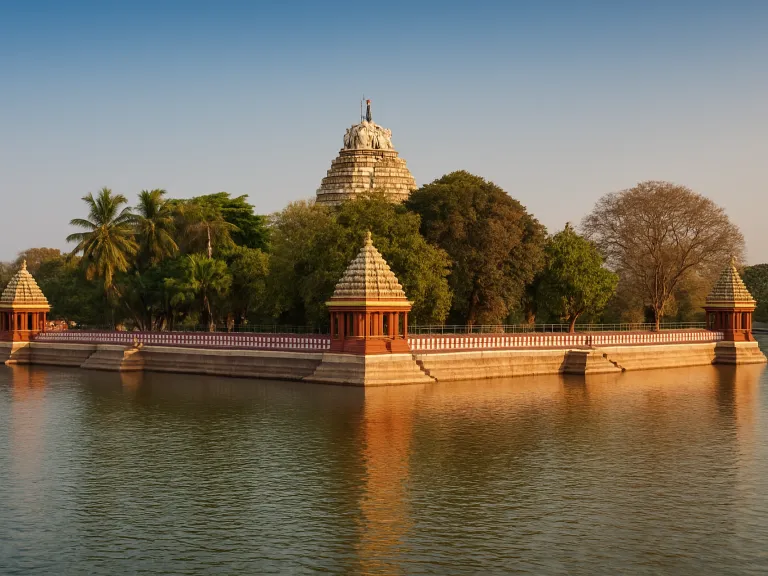
Vandiyur Mariamman Teppakulam is a monumental temple tank laid out on a large geometric plan. It is commonly described as measuring about 305 metres by 290 metres, with a broad expanse of water enclosed by long sides of dressed stone steps. The stepped edges allow access to the water and also create a grand visual frame for festival gatherings. The scale of the tank makes it one of the most imposing historic water structures in Madurai.
At the centre of the tank stands an island with a mandapam and a shrine associated with Vinayakar. This central feature is the architectural focus of the whole composition. The surrounding water, the axial view toward the island, and the open sky above the tank produce a ceremonial setting suited to the Theppotsavam. During the float festival, the central pavilion and the tank’s perimeter become part of a large-scale ritual stage.
The tank’s architecture reflects Nayak-period planning, in which sacred function, urban spectacle and hydraulic design were combined. Its stone revetments and continuous steps show the practical need to hold and access water, while the island pavilion and festival use show its ritual purpose. Unlike a temple complex dominated by gopurams and enclosed prakara corridors, the Teppakulam is an open-air sacred water monument whose form is defined by proportion, water, stone steps and processional movement.
🌳
Sacred Features
💧 Temple Tank
Vandiyur Mariamman Teppakulam
A major Nayak-period sacred tank in Madurai, used as the ceremonial venue for the Meenakshi Sundareswarar Float Festival and associated with the nearby Vandiyur Mariamman Temple.
✨
Temple Highlights
✨
Historic Nayak-period tank
The Teppakulam is associated with King Thirumalai Nayak and is dated to the 17th century, making it an important monument of Madurai’s Nayak heritage.
✨
Venue of the Meenakshi Sundareswarar Float Festival
The annual Theppotsavam brings the processional images of Meenakshi and Sundareswarar from the Meenakshi Amman Temple to this tank for a ceremonial float procession.
✨
Large stone-lined water structure
The tank is known for its vast rectangular layout, broad stone steps and open ceremonial character.
✨
Central island mandapam
A mandapam and shrine stand on the island at the centre of the tank, forming the visual and ritual focus of the site.
✨
Association with Vandiyur Mariamman
The tank takes its popular name from the nearby Vandiyur Mariamman Temple, connecting it with the worship of the local guardian goddess.
🙏
Spiritual Benefits
Devotees seek the blessings of Mariamman for protection and family welfare.
Devotees pray to Mariamman for relief from illness and afflictions.
Worshippers seek the grace of Meenakshi and Sundareswarar during the float festival.
Devotees pray to Vinayakar for the removal of obstacles before important undertakings.
The sacred water setting is valued for reflection, devotion and participation in community worship.
🎉
Major Festivals
🎉
Meenakshi Sundareswarar Theppotsavam
The annual float festival is held in the Tamil month of Thai, around Thai Poosam. The processional images of Meenakshi and Sundareswarar are brought from the Meenakshi Amman Temple and placed on a decorated float that moves around the Teppakulam.
🚗
How to Reach
🛣️
By Road
Vandiyur Mariamman Teppakulam is located in the Vandiyur area of Madurai and can be reached by city buses, taxis and auto-rickshaws from major parts of the city, including the Meenakshi Amman Temple area and Madurai railway station.
🚆
By Rail
The nearest major railway station is Madurai Junction. From the station, local transport is available to Vandiyur Mariamman Teppakulam.
✈️
By Air
The nearest airport is Madurai Airport. Taxis and app-based transport are available from the airport to Vandiyur and central Madurai.
💡
Visitor Tips
Check the announced date and arrangements for the Theppotsavam before planning a festival visit.
Expect large crowds and traffic diversions around the tank during the float festival.
Use public transport or hired local transport during major festival days, as parking can be limited.
Respect barricades and safety instructions around the water and festival areas.
Visit in the early morning or evening during non-festival days for a more comfortable experience.
Combine the visit with Meenakshi Amman Temple and Thirumalai Nayakkar Mahal to understand Madurai’s Nayak-period heritage.
Carry drinking water during daytime visits, especially in the warmer months.

 WhatsApp Us