🛕About Temple
The Shore Temple at Mamallapuram, also known as Mahabalipuram, is one of the most celebrated monuments of early medieval South India. Standing close to the Bay of Bengal in Chengalpattu district of Tamil Nadu, it forms part of the UNESCO-listed Group of Monuments at Mahabalipuram. Unlike the earlier rock-cut caves and monolithic rathas at the site, the Shore Temple is a structural temple built with dressed stone blocks, making it a major landmark in the development of South Indian temple architecture.
The monument is primarily associated with Shiva, with two shrines containing Shiva lingas, and it also includes a shrine for Vishnu in the reclining Anantashayana form. Its seafront position has made it an emblem of Mamallapuram, a Pallava port settlement that connected the Tamil coast with wider maritime trade routes. The temple’s towers rising against the sea gave it a distinctive profile that was noted by early travellers and later became linked with the maritime memory of the “Seven Pagodas.”
Today, the Shore Temple is protected as an archaeological monument and is valued for its history, architecture, sculpture, and coastal setting. It is not mainly known as a regular ritual temple with continuous daily worship in the modern sense; its importance rests on its Pallava-period religious design and its role in the architectural transition from excavated rock monuments to freestanding stone temples. The temple remains one of the most visited heritage sites in Tamil Nadu.
ℹ️Temple Information
⭐
Temple Type
Shaiva temple, Vaishnava shrine, Structural stone temple, Pallava monument, UNESCO World Heritage monument
📅
Built Period
Early 8th century CE
🏛
Dynasty
Pallava dynasty
Need Help Planning your visit to
Shore Temple?
Our travel experts can help you with transportation,
darshan timings, nearby sightseeing and complete temple tour planning.
⭐Temple Significance
The Shore Temple is significant as one of the earliest surviving structural stone temples of the Pallava period and as a key monument in the development of Dravida architecture. It is part of the UNESCO World Heritage-listed Group of Monuments at Mahabalipuram and preserves evidence of Pallava royal patronage, Shaiva and Vaishnava iconography, and the maritime importance of ancient Mamallapuram.
📜History
The Shore Temple was built during the Pallava period, most closely associated with King Narasimhavarman II, also known as Rajasimha, who ruled in the early 8th century CE. Mamallapuram had already become an important artistic centre under earlier Pallava rulers, especially Narasimhavarman I Mamalla, after whom the town’s historic name is connected. The Shore Temple represents a later phase in this tradition, when Pallava architects moved from rock-cut cave shrines and monolithic experiments toward fully structural stone temples.
The complex is historically significant because it shows the mature Pallava contribution to the Dravida temple form. Inscriptions and architectural study connect the temple with Rajasimha’s reign, a period also known for the Kailasanatha Temple at Kanchipuram. The names associated with the Shiva shrines, including Kshatriyasimhesvara and Rajasimhesvara, reflect royal Pallava titulature. The inclusion of a Vishnu shrine within the same complex also demonstrates the plural religious landscape patronized by the Pallava court.
Located on the Coromandel Coast, the temple was exposed for centuries to salt-laden winds, sand, and sea erosion. Its survival is therefore historically remarkable. The monument attracted attention from colonial-era antiquarians and later came under systematic archaeological protection. In 1984, the Group of Monuments at Mahabalipuram, including the Shore Temple, was inscribed as a UNESCO World Heritage Site. Conservation work has focused on stabilizing the monument and protecting it from marine weathering while preserving its Pallava identity.
🕉️Mythology
The mythological and legendary associations of the Shore Temple are closely tied to Mamallapuram’s coastal landscape. The most famous tradition is the memory of the “Seven Pagodas,” a name used by European mariners for the temple towers seen from the sea. Maritime lore described a group of temples or pagodas standing along the coast, with only one visible above the shore in later times. This tradition belongs to local and seafaring legend rather than verified architectural history.
The presence of Shiva and Vishnu shrines gives the complex a sacred symbolic dimension. The reclining Vishnu, known as Anantashayana, represents Vishnu resting on the cosmic serpent Ananta, a form associated with preservation, cosmic order, and the interval between cycles of creation. The Shiva shrines, containing lingas, express the aniconic form of Shiva worship that was central to many Pallava-period temples. The pairing of Shiva and Vishnu within one seaside complex has encouraged devotional readings of harmony between major Hindu traditions.
Local tradition also connects Mamallapuram with stories of the sea covering older structures. After the 2004 Indian Ocean tsunami, some submerged and buried remains near the coast drew renewed attention to longstanding local memories of lost monuments. These remains support the understanding that the ancient site was more extensive than what is immediately visible, but the precise identification of legendary “seven” temples is not established as historical fact. The mythology of the Shore Temple therefore remains a blend of sacred imagery, coastal memory, and maritime imagination.
🏛Architecture
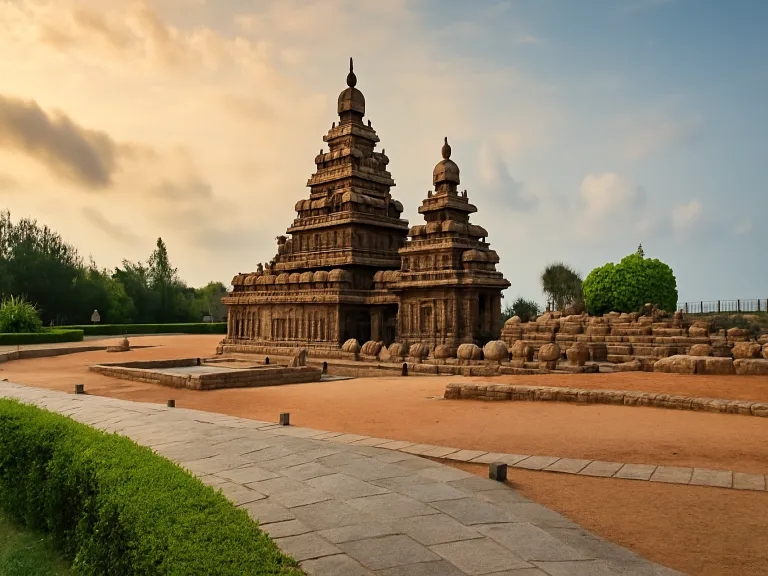
The Shore Temple is a landmark example of early structural Dravida architecture in South India. Built of dressed granite blocks, it differs from the nearby Pallava cave temples and monolithic rathas, which were excavated or carved from living rock. The complex consists of two Shiva shrines aligned on an east-west axis and a smaller Vishnu shrine with a reclining image. The larger east-facing Shiva shrine is the most prominent element, with a tiered pyramidal superstructure rising above the sanctum.
The temple’s form shows the Pallava experiment with the architectural vocabulary that later became central to South Indian temple design. Its vimanas are composed of diminishing storeys, crowned by finials, and the walls contain sculptural niches and decorative elements. A row of seated Nandi figures is a notable feature of the enclosure, reinforcing the Shaiva identity of the complex. The Vishnu shrine, placed between the Shiva elements, contains the reclining Vishnu form, adding iconographic variety within a compact sacred layout.
The temple’s coastal location has shaped both its visual impact and its condition. Granite gave the structure durability, but centuries of exposure to salt spray, wind, and sand have softened many sculptural details. The weathered surfaces are part of the monument’s present character, while conservation measures aim to slow further deterioration. Architecturally, the Shore Temple is especially important because it stands at the turning point between Pallava rock-cut experimentation and the later, more expansive stone temple traditions of Tamil Nadu.
✨
Temple Highlights
✨
UNESCO World Heritage Monument
The Shore Temple is part of the Group of Monuments at Mahabalipuram, inscribed as a UNESCO World Heritage Site in 1984 for its outstanding Pallava art and architecture.
✨
Early Structural Stone Temple
It is among the important early examples of freestanding structural temple architecture in Tamil Nadu, built with dressed stone blocks rather than carved from a single rock mass.
✨
Pallava Royal Patronage
The temple is associated with the reign of Pallava king Narasimhavarman II Rajasimha, a major patron of early Dravida temple architecture.
✨
Shaiva and Vaishnava Shrines
The complex contains two Shiva shrines with lingas and a shrine with Vishnu in the reclining Anantashayana form.
✨
Seafront Setting
Its location on the Bay of Bengal gives the temple its iconic profile and connects it with the old maritime memory of Mamallapuram.
✨
Nandi Enclosure
Rows of seated Nandi sculptures around the complex emphasize the Shaiva character of the temple and form a striking visual feature.
🙏
Spiritual Benefits
Contemplation on Shiva through the linga form preserved in the ancient sanctums
Reflection on Vishnu in the Anantashayana form, symbolizing cosmic preservation
Experience of sacred art created under Pallava royal patronage
Awareness of harmony between Shaiva and Vaishnava imagery within one complex
Meditative appreciation of the temple’s seafront setting and ancient sacred atmosphere
🎉
Major Festivals
🎉
Mamallapuram Dance Festival
A cultural dance festival held in Mamallapuram, featuring classical Indian dance performances near the historic monument setting. It is a cultural event associated with the heritage town rather than a documented temple ritual festival of the Shore Temple.
🚗
How to Reach
🛣️
By Road
Mamallapuram is accessible by road from Chennai and Puducherry via the East Coast Road. Buses, taxis, and private vehicles commonly connect the town with Chennai and nearby coastal destinations.
🚆
By Rail
Mamallapuram does not have a major railway station at the monument site. Chengalpattu is a commonly used railhead for reaching Mamallapuram by onward road transport.
✈️
By Air
The nearest major airport is Chennai International Airport, from where Mamallapuram can be reached by road.
💡
Visitor Tips
Check current visiting hours and ticketing details from official sources before travelling.
Carry water and sun protection, as the monument is in an open coastal setting.
Visit early morning or late afternoon for more comfortable weather and better light.
Allow time to see the wider Group of Monuments at Mahabalipuram, not only the Shore Temple.
Avoid touching sculptures or climbing on protected architectural remains.
Respect barricades and conservation instructions at the site.
Wear footwear that is comfortable for walking around stone and sand surfaces.
Keep the premises clean and avoid littering near the seashore monument.

 WhatsApp Us