🛕About Temple
Swarnapureeswarar Temple at Semponnarkoil, also written Sembanarkoil, is an ancient Shiva temple in the Mayiladuthurai region of Tamil Nadu. The presiding deity is worshipped as Swarnapureeswarar, a Sanskrit name meaning the Lord of the golden sacred place, and the goddess is worshipped as Maruvarkuzhali. The temple belongs to the Tamil Shaiva sacred geography of the Kaveri delta, an area noted for closely spaced Tevaram shrines, medieval temple settlements and long-continuing ritual traditions.
The temple is widely identified with the Tevaram sthalam known as Tiruchchemponpalli or Thirusemponpalli. Its importance rests especially on its inclusion among the Paadal Petra Sthalams, the Shiva temples praised in the canonical hymns of the Nayanmars. The association with Tirugnana Sambandar places the shrine within the devotional movement of the 7th century CE and shows that the sacred site was already revered before the later medieval phase of temple building in the region.
Semponnarkoil lies on the route connecting Mayiladuthurai with the coastal and delta towns around Thirukkadaiyur and Tarangambadi. The temple is visited by devotees of Shiva, pilgrims following the Tevaram circuit, and travellers exploring historic Chola-country temples. The available historical record does not securely identify a single founder. For that reason, the temple is best described as an early Shaiva shrine documented by Tevaram tradition, with later structural and ritual history connected to the broader Chola-period temple culture of the Kaveri delta.
ℹ️Temple Information
🛕
Presiding Deity
Swarnapureeswarar
⭐
Temple Type
Shiva temple, Paadal Petra Sthalam, Tevaram shrine, Tamil Nadu Dravidian temple
📅
Built Period
At least 7th century CE, as the shrine is attested in the Tevaram hymns of Tirugnana Sambandar; later structural phases belong to the medieval temple culture of the Chola country.
🏛
Dynasty
Chola country; a specific founding ruler is not securely documented.
🙏
Sampradaya
Shaivism, within the Tamil Saiva devotional tradition.
Need Help Planning your visit to
Arulmigu Swarnapureeswarar Temple?
Our travel experts can help you with transportation,
darshan timings, nearby sightseeing and complete temple tour planning.
⭐Temple Significance
Swarnapureeswarar Temple is significant as the Tevaram shrine of Tiruchchemponpalli, praised by Tirugnana Sambandar and counted among the Paadal Petra Sthalams. It represents the continuity of Tamil Shaiva worship in the Kaveri delta from the early medieval period to the present.
📜History
The most secure historical marker for Swarnapureeswarar Temple is its place in the Tevaram canon. Tirugnana Sambandar, one of the three principal Nayanmar saints whose hymns form the core of the Tevaram, praised the shrine of Tiruchchemponpalli. This establishes the sacred status of the temple by the 7th century CE. The hymn tradition is historically important because it records a network of active Shiva shrines before the great expansion of stone temple architecture under the imperial Cholas.
The temple stands in the old Chola country, within the fertile Kaveri delta. This region saw sustained patronage to Shiva temples from Chola rulers, local chiefs, merchant groups and agrarian assemblies. While many temples in the Mayiladuthurai region preserve layers of construction and renovation from the medieval period, a specific royal founder for Swarnapureeswarar Temple is not securely established in widely available historical summaries. The shrine’s antiquity is therefore best stated from its Tevaram attestation rather than from an unsupported foundation legend.
The historical name Tiruchchemponpalli is reflected in the modern place-name Semponnarkoil. The Tamil word “sempon” means refined or pure gold, corresponding to the Sanskrit “swarna” in Swarnapureeswarar. The continuity between the old sacred name, the present village name and the deity’s name shows the lasting identity of the temple across religious literature, local usage and pilgrimage memory. The temple remains a part of the living Shaiva tradition of the region rather than a monument known only from archaeology.
🕉️Mythology
The mythology of Swarnapureeswarar Temple is centred on the sacred idea contained in the name of the place and deity. “Sempon” in Tamil and “swarna” in Sanskrit both refer to gold, not merely as wealth but as purity, auspiciousness and divine radiance. In the temple’s sacred interpretation, Shiva as Swarnapureeswarar is the lord who grants inner brightness, removes spiritual dullness and makes the devotee’s life worthy like refined gold.
Local Shaiva tradition connects the shrine with the devotional world celebrated in the Tevaram hymns. In that tradition, the Nayanmar saints did not treat temples simply as buildings; they described them as living spaces where Shiva was present, worshipped by devotees, served by ritual, and surrounded by sacred landscape. The mythology of Tiruchchemponpalli therefore belongs to this larger Tamil Shaiva imagination, where the deity, the place-name, the goddess and the devotee’s prayer form a single sacred field.
No single detailed sthala-purana episode that can be treated as historically verifiable is provided here. The temple’s mythological importance can be stated with confidence through its name, its Shaiva identity and its place in the hymnal tradition. Devotees approach Swarnapureeswarar for grace, purification, prosperity rightly understood, and steadiness of mind. The goddess Maruvarkuzhali represents the compassionate presence of Shakti, completing the temple’s mythology as a shrine where Shiva and the Divine Mother are worshipped together.
🏛Architecture
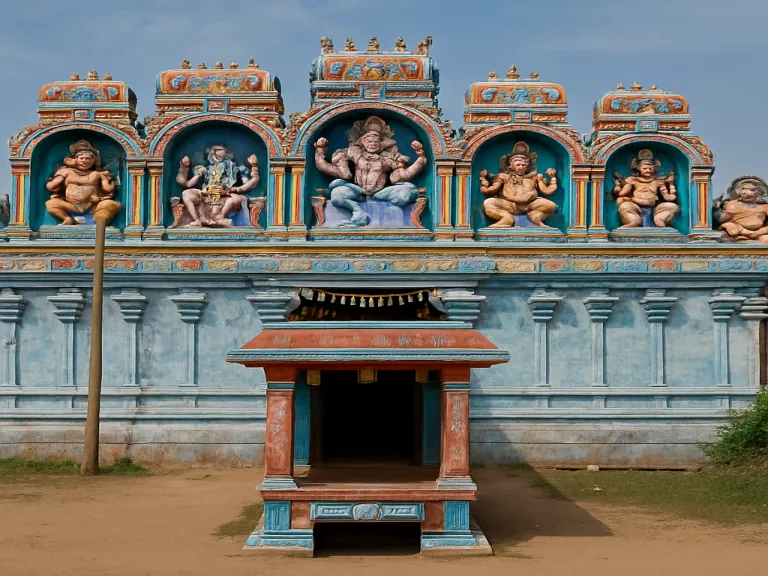
Swarnapureeswarar Temple follows the broad Dravidian Shaiva temple pattern of the Kaveri delta. The principal object of worship is the Shiva linga of Swarnapureeswarar in the sanctum, with Nandi placed on the axial line of worship in front of Shiva according to standard Shaiva temple arrangement. The goddess Maruvarkuzhali has her own shrine within the sacred complex, reflecting the established Tamil practice of worshipping Shiva and Ambal as complementary divine presences.
The architectural character of temples in this region is shaped by stone sanctums, mandapas for worship and circumambulation, subsidiary shrines and enclosure spaces that support daily ritual. Swarnapureeswarar Temple is not primarily known for a single monumental feature on the scale of the largest Chola imperial temples; its importance lies in continuity, antiquity and its place in the Tevaram network. The layout serves liturgical movement, allowing devotees to worship the main deity, the goddess and the associated deities of a Shaiva temple circuit.
The present structure represents accumulated temple history rather than a single dated construction campaign known from a named patron. For that reason, no unsupported claim is made here about a specific architect, founder or exact construction year. Architecturally, the temple should be understood as a historic Tamil Shiva temple of the Kaveri delta, preserving the ritual grammar of garbhagriha, mandapa, prakara and subsidiary worship spaces. Its sacred value is inseparable from the Tevaram tradition that identifies the site as Tiruchchemponpalli.
✨
Temple Highlights
✨
Paadal Petra Sthalam
The temple is identified with Tiruchchemponpalli, a Shiva shrine praised in the Tevaram hymns of Tirugnana Sambandar.
✨
Swarnapureeswarar shrine
The presiding deity is Shiva as Swarnapureeswarar, the Lord associated with the golden sacred place indicated by the name Semponnarkoil.
✨
Maruvarkuzhali Amman
The goddess of the temple is worshipped as Maruvarkuzhali, representing the compassionate presence of Shakti in the shrine.
✨
Kaveri delta sacred geography
The temple stands in the Mayiladuthurai region, a dense pilgrimage landscape of ancient Shiva temples and Tevaram sites.
✨
Continuity of worship
The shrine remains a living place of Shaiva worship rather than only a historical monument.
🙏
Spiritual Benefits
Devotees pray for purification of mind and conduct.
Devotees seek the grace of Shiva for inner strength and clarity.
The name Swarnapureeswarar inspires prayers for auspicious prosperity guided by dharma.
Worship of Shiva and Maruvarkuzhali together is sought for harmony in family life.
Pilgrims value the temple for connection with the Tevaram hymnal tradition.
Pradosha worship is considered spiritually meritorious in Shaiva practice.
Devotees pray for removal of obstacles and renewal of devotion.
🎉
Major Festivals
🎉
Maha Shivaratri
The great night of Shiva is an important Shaiva observance. Devotees usually perform night worship, abhishekam and prayers to Shiva; visitors should confirm the local schedule with the temple.
🎉
Pradosham
Pradosham, observed twice each lunar month, is a major Shaiva worship time associated with Shiva and Nandi. Local timings should be confirmed before visiting.
🎉
Arudra Darshan
Arudra Darshan in the Tamil month of Margazhi is associated with Shiva as Nataraja and is widely observed in Shaiva temples.
🎉
Aippasi Annabhishekam
Annabhishekam to Shiva in the Tamil month of Aippasi is a widely observed Shaiva ritual in Tamil Nadu temples.
🎉
Karthigai Deepam
Karthigai Deepam is an important Tamil festival of lamps and devotion, observed in many Shiva temples.
🪔
Special Poojas
🪔
Abhishekam to Swarnapureeswarar
Ritual bathing of the Shiva linga is central to Shaiva worship. Availability and timings should be confirmed locally.
🪔
Archana to Swarnapureeswarar
Name-recitation worship may be offered to the presiding deity according to temple practice.
🪔
Archana to Maruvarkuzhali Amman
Devotees may offer prayers to the goddess Maruvarkuzhali for grace and family welfare according to local practice.
🪔
Pradosha Pooja
Pradosha worship is a significant Shaiva observance dedicated to Shiva and Nandi.
🪔
Maha Shivaratri Pooja
Special worship is associated with Maha Shivaratri, one of the most important nights for Shiva devotees.
🚗
How to Reach
🛣️
By Road
Semponnarkoil is accessible by road from Mayiladuthurai on the route toward Thirukkadaiyur and Tarangambadi. Local buses, taxis and private vehicles operate in this region.
🚆
By Rail
The nearest major railhead is Mayiladuthurai Junction, from where Semponnarkoil can be reached by road.
✈️
By Air
The nearest major airport commonly used for this region is Tiruchirappalli International Airport, followed by onward travel by road or rail to Mayiladuthurai and Semponnarkoil.
💡
Visitor Tips
Confirm the current opening hours with the temple or local residents before travelling.
Mayiladuthurai is a practical base for visiting Semponnarkoil and nearby Tevaram temples.
Wear modest clothing suitable for a traditional Hindu place of worship.
Carry cash for offerings, as small temples may not support digital payments at all times.
Ask temple authorities before taking photographs, especially inside the temple complex.
Plan extra time if combining the visit with Thirukkadaiyur, Mayiladuthurai or other nearby shrines.
Visit early in the morning or evening for more comfortable weather in the delta region.

 WhatsApp Us