🛕About Temple
Abirami Amman Samedha Sri Amirthakadeswarar Devasthanam is the celebrated Shiva temple at Thirukkadaiyur in Mayiladuthurai district, Tamil Nadu. The presiding deity is Sri Amirthakadeswarar, a form of Shiva worshipped in the form of a lingam, and the divine consort is Sri Abirami Amman. The temple is one of the most visited shrines in the Cauvery delta and is closely associated with prayers for long life, family welfare, and release from fear of untimely death.
Thirukkadaiyur is revered in the Tamil Shaiva canon as a Paadal Petra Sthalam, praised in the Tevaram hymns of the Nayanmars. The temple’s sacred identity is shaped by the Markandeya legend, in which Shiva appears as Kalasamharamurti and subdues Yama to protect the young devotee Markandeya. Because of this association, the temple is a major centre for Ayushya-related rituals, including Sashtiapthapoorthi, Bheema Ratha Shanti, and Sathabhishekam.
The temple is also inseparable from the devotion to Abirami Amman and the eighteenth-century saint-poet Abirami Pattar, whose Abirami Andhadhi remains one of the most beloved Tamil hymns to the goddess. The complex contains shrines for Amirthakadeswarar, Abirami Amman, Kalasamharamurti, Markandeya, and other deities of the Shaiva tradition. Administered as an active temple with daily worship and major festivals, Thirukkadaiyur continues to function as both an ancient sacred site and a living centre of Tamil devotional practice.
ℹ️Temple Information
🛕
Presiding Deity
Sri Amirthakadeswarar
👸
Goddess
Sri Abirami Amman
⭐
Temple Type
Shiva temple, Paadal Petra Sthalam, Dravidian temple, Longevity and Ayushya prayer temple
📅
Built Period
The temple was a celebrated shrine by the 7th century CE; the extant structural complex reflects early medieval Chola-period development from about the 10th century CE onward.
Need Help Planning your visit to
Sri Abirami Amman Samedha Sri Amirthakadeswarar Devasthanam?
Our travel experts can help you with transportation,
darshan timings, nearby sightseeing and complete temple tour planning.
⭐Temple Significance
Thirukkadaiyur is a Paadal Petra Sthalam and one of the foremost Shiva temples associated with victory over death through the Markandeya legend. It is especially significant for devotees performing longevity-related rites such as Sashtiapthapoorthi, Bheema Ratha Shanti, Sathabhishekam, and Ayushya prayers. The temple is also a major centre of Abirami Amman worship through the legacy of Abirami Pattar and the Abirami Andhadhi.
📜History
Thirukkadaiyur is historically important because it is included among the Paadal Petra Sthalams, the Shiva temples praised in the Tevaram hymns. The hymns of the early medieval Nayanmars establish that the shrine was already an important place of worship by the 7th century CE. This literary evidence places the sacred status of Thirukkadaiyur firmly within the formative period of Tamil Shaiva bhakti, when temples across the Cauvery region became centres of liturgy, music, pilgrimage, and royal patronage.
The existing temple complex reflects the growth of a Chola-period stone temple and later additions made across subsequent centuries. Inscriptions found in many ancient temples of the Cauvery delta record gifts of land, lamps, gold, and provisions for worship, and Thirukkadaiyur belongs to this wider historical landscape of Chola temple culture. The Chola rulers and local donors supported Shaiva temples as institutions of worship, learning, land management, and community identity. The temple’s continuity of worship is therefore both religious and historical.
In later centuries, the shrine gained further prominence through the devotional memory of Abirami Pattar, associated with the Thanjavur Maratha period. His Abirami Andhadhi placed Abirami Amman at the centre of Tamil goddess devotion and strengthened the temple’s reputation beyond the immediate region. Today the temple is widely known for longevity ceremonies performed by devotees from Tamil Nadu and other parts of India. Its history is best understood as a combination of early Shaiva canonical sanctity, Chola-period institutional development, later devotional traditions, and continuous living worship.
🕉️Mythology
The principal mythology of Thirukkadaiyur is connected with Markandeya and Shiva’s victory over Yama. According to the temple’s sacred tradition, the sage Mrikandu and his wife Marudvati received a divine choice between a dull long-lived son and a brilliant son destined to live only sixteen years. They chose the virtuous child, and Markandeya was born. From childhood he worshipped Shiva with unwavering devotion and embraced the lingam when the appointed moment of death arrived.
When Yama cast his noose to take Markandeya’s life, the noose encircled the Shiva lingam. Shiva emerged in fierce form as Kalasamharamurti and subdued Yama, protecting Markandeya and granting him the blessing of everlasting youth. This myth gives Thirukkadaiyur its strong association with longevity, overcoming fear of death, and divine grace that transcends fate. The temple’s Kalasamharamurti shrine and the presence of Markandeya in the temple tradition keep this episode central to worship.
Another cherished tradition concerns Abirami Pattar, a devotee of Abirami Amman. During the reign of the Thanjavur Maratha king Serfoji I, the devotee, absorbed in the goddess, declared a new-moon day to be a full-moon day. When challenged, he sang the Abirami Andhadhi in praise of the goddess. In the devotional account, Abirami Amman cast her radiant earring into the sky, making it shine like the full moon and saving her devotee. This tradition made the Abirami Andhadhi a central hymn of goddess devotion at Thirukkadaiyur.
🏛Architecture
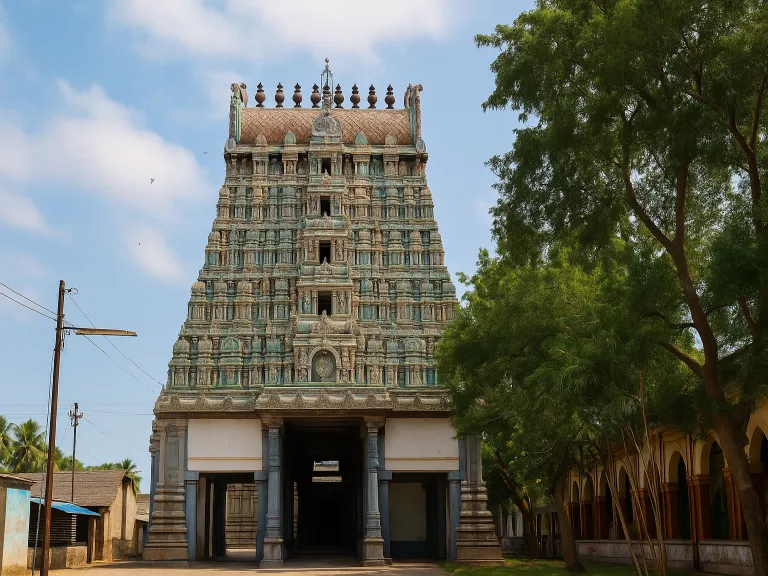
The temple is built in the Dravidian architectural tradition characteristic of the Cauvery delta’s major Shaiva shrines. The complex is organized around the sanctum of Sri Amirthakadeswarar, with separate and prominent space for Sri Abirami Amman. The layout includes concentric enclosures, pillared mandapas, subsidiary shrines, temple corridors, and gateways that support both daily worship and large festival movement. As in many ancient Tamil temples, architecture and ritual movement are closely connected.
The main shrine of Amirthakadeswarar enshrines Shiva as a lingam, while the goddess shrine of Abirami Amman is a major devotional focus in its own right. The temple also has important icons and shrines connected with the Markandeya legend, including Kalasamharamurti. Sculptural and iconographic elements present Shiva in multiple aspects: the benevolent lord who grants grace, the fierce protector who conquers death, and the cosmic deity surrounded by the standard retinue of Shaiva worship.
The mandapas are used for festival processions, special rites, and the widely performed longevity ceremonies for devotees. The temple’s architectural experience is not limited to ornament; it is shaped by ritual use, circumambulation, recitation, and the presence of many shrines within a sacred enclosure. The visual emphasis on gopurams, stone corridors, bronze processional deities, and carved pillars reflects the layered growth of the temple across centuries. The result is a living Dravidian temple complex where early Shaiva sanctity, Chola-period temple culture, and later devotional traditions remain visible through worship and built form.
🌳
Sacred Features
🌳 Temple Tree
Pinjilam
Recognized in temple tradition as the sthala vriksha of Thirukkadaiyur.
💧 Temple Tank
Amrita Pushkarini
The sacred temple tank is associated with the temple’s amrita-related sanctity and is part of the sacred geography of Thirukkadaiyur.
✨
Temple Highlights
✨
Paadal Petra Sthalam
Thirukkadaiyur is one of the Shiva temples praised in the Tevaram hymns of the Nayanmars, establishing its importance in Tamil Shaiva bhakti tradition.
✨
Markandeya and Kalasamharamurti legend
The temple is the sacred site associated with Shiva protecting Markandeya and subduing Yama, giving the shrine its strong connection with longevity prayers.
✨
Abirami Amman worship
The goddess Abirami Amman is a major focus of devotion, especially through the celebrated Abirami Andhadhi composed by Abirami Pattar.
✨
Longevity ceremonies
The temple is renowned for Sashtiapthapoorthi, Bheema Ratha Shanti, Sathabhishekam, Ayush Homam, and other family rituals connected with long life and wellbeing.
✨
Living Dravidian temple complex
The temple contains multiple shrines, mandapas, corridors, gopurams, and processional spaces used in daily worship and annual festivals.
🙏
Spiritual Benefits
Devotees pray for long life and healthy ageing.
Devotees seek relief from fear of untimely death through worship of Kalasamharamurti.
Couples and families perform milestone-life rituals such as Sashtiapthapoorthi and Sathabhishekam.
Devotees pray for family welfare, harmony, and prosperity.
Worship of Abirami Amman is sought for compassion, protection, and inner strength.
Recitation of Abirami Andhadhi is valued for devotion to the goddess.
Ayushya-related homams are performed for wellbeing and longevity.
🎉
Major Festivals
🎉
Maha Shivaratri
Maha Shivaratri is an important festival for the worship of Shiva, observed with special abhishekam, pooja, and devotional participation.
🎉
Annual Brahmotsavam
The temple celebrates an annual Brahmotsavam with processions and festival worship connected with the presiding deities.
🎉
Navaratri
Navaratri is celebrated with special worship of Abirami Amman, reflecting the temple’s strong goddess tradition.
🎉
Aadi Pooram
Aadi Pooram is observed as an important festival for the goddess, with special worship of Abirami Amman.
🎉
Pradosham
Pradosham is observed regularly as an important Shiva worship day, drawing devotees for evening worship.
🎉
Karthigai Deepam
Karthigai Deepam is observed with lamps and special worship as part of the Tamil Shaiva festival calendar.
🪔
Special Poojas
🪔
Sashtiapthapoorthi
A milestone ceremony commonly performed when a person completes 60 years, seeking blessings for health, longevity, and family welfare.
🪔
Bheema Ratha Shanti
A longevity rite generally performed around the completion of 70 years, with homam and temple worship.
🪔
Sathabhishekam
A major life-cycle ceremony associated with advanced age, performed with prayers for continued wellbeing and divine grace.
🪔
Ayush Homam
A homam performed for health, longevity, and protection, especially for children and family members.
🪔
Mrityunjaya Homam
A Shiva homam connected with prayers for relief from fear, illness, and untimely death.
🪔
Abhishekam to Amirthakadeswarar
Ritual bathing and worship of the presiding Shiva lingam, performed as part of regular and special worship.
🪔
Special worship to Abirami Amman
Devotees offer special poojas to Abirami Amman for protection, compassion, family welfare, and spiritual strength.
🚗
How to Reach
🛣️
By Road
Thirukkadaiyur is on the Mayiladuthurai-Karaikal route and is accessible by buses, taxis, and private vehicles from Mayiladuthurai, Sirkazhi, Chidambaram, and Karaikal.
🚆
By Rail
The nearest major railway access is Mayiladuthurai Junction, with onward road transport to Thirukkadaiyur. Sirkazhi and Karaikal are also used by travellers depending on route convenience.
✈️
By Air
The nearest major airport commonly used by pilgrims is Tiruchirappalli International Airport, with onward travel by road or rail through the Cauvery delta region.
💡
Visitor Tips
Confirm current temple timings and pooja arrangements with the devasthanam before planning special ceremonies.
Book longevity ceremonies in advance, especially during auspicious dates and weekends.
Expect larger crowds during Maha Shivaratri, Navaratri, Brahmotsavam, and popular muhurtham days.
Wear modest clothing suitable for temple worship.
Arrive early if attending a scheduled homam or family ceremony.
Keep sufficient time for darshan at both Amirthakadeswarar and Abirami Amman shrines.
Follow temple staff instructions regarding queues, offerings, and restricted areas.
Check local transport options in advance if travelling from Mayiladuthurai, Sirkazhi, or Karaikal.

 WhatsApp Us