🛕About Temple
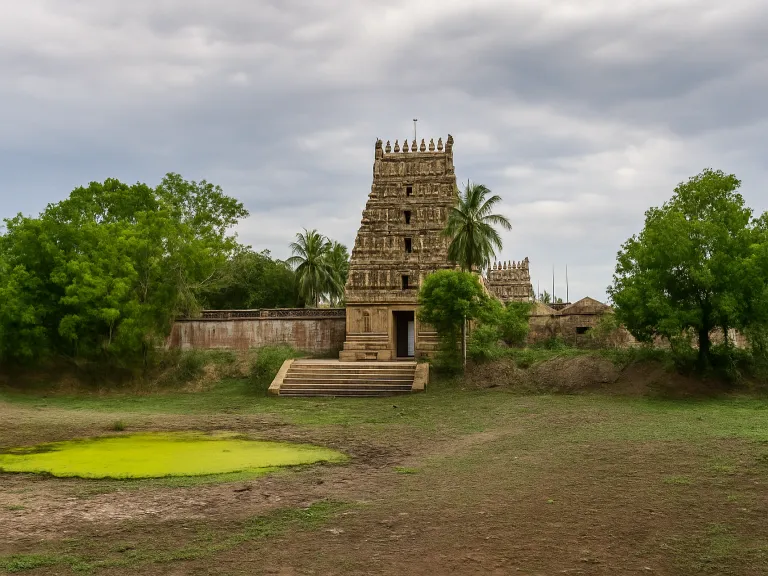
Veeratteswarar Temple at Thirukkurukkai, also written as Tirukkurukkai or Kurukkai, is a Shiva temple in the Mayiladuthurai region of Tamil Nadu. The presiding deity is Shiva as Veeratteswarar, worshipped in the form of a Sivalinga, and the goddess is Gnanambikai. The temple is part of the sacred Shaiva landscape of the former Chola country and is known especially for its connection with the Kama Dahana episode.
Thirukkurukkai is one of the Ashta Veerattanam temples, the eight shrines where Shiva is venerated for heroic acts described in Shaiva puranic and temple traditions. In this shrine, the associated act is the burning of Kama, the god of desire, when Kama disturbed Shiva’s yogic meditation. This identity gives the temple a distinctive place among Tamil Shiva temples.
The temple is also a Tevaram shrine, meaning it is praised in the canonical hymns of the Tamil Shaiva saints. Its importance therefore rests on both Tamil devotional literature and the continuing worship of Shiva as the lord who conquers desire. Devotees visit the temple for darshan of Veeratteswarar, worship of Gnanambikai, and remembrance of Shiva’s supreme yogic power.
ℹ️Temple Information
🛕
Presiding Deity
Veeratteswarar
⭐
Temple Type
Shiva temple, Paadal Petra Sthalam, Ashta Veerattanam temple
📅
Built Period
At least 7th century CE, as the shrine is praised in the Tevaram tradition.
Need Help Planning your visit to
Arulmigu Veeratteswarar Temple?
Our travel experts can help you with transportation,
darshan timings, nearby sightseeing and complete temple tour planning.
⭐Temple Significance
Veeratteswarar Temple, Thirukkurukkai, is significant as one of the Ashta Veerattanam temples and as a Tevaram Paadal Petra Sthalam. It is specially associated with Shiva’s Kama Dahana act, symbolizing the conquest of uncontrolled desire through divine awareness and yogic power.
📜History
The documented sacred history of Veeratteswarar Temple is anchored in the Tamil Shaiva canon. Thirukkurukkai is counted among the Paadal Petra Sthalams, the Shiva temples praised in the Tevaram hymns. This establishes the shrine as an active and revered place of worship by the 7th century CE, the period of the principal Nayanmar saints whose hymns shaped Tamil Shaiva devotion.
The temple belongs to the group of shrines in the Chola country north of the Kaveri, a region with dense early medieval Shaiva temple activity. Its association with the Ashta Veerattanam group is part of a long-standing Tamil Shaiva sacred geography in which particular temples are linked to Shiva’s fierce or heroic manifestations. At Thirukkurukkai, the heroic manifestation is Kama Dahana, the destruction of desire.
No historically secure founder can be stated from widely established information. The present temple, like many ancient Tamil temples, reflects layers of worship, maintenance, structural renewal, and local patronage over many centuries. While the shrine’s antiquity is clear from its presence in the Tevaram tradition, a precise original builder, construction year, or single dynastic attribution should not be assigned without specific epigraphic evidence.
🕉️Mythology
According to the temple’s sthala-purana tradition, the gods sought Shiva’s union with Parvati for the welfare of the world. Shiva was absorbed in deep yogic meditation, and Kama, the god of desire, was sent to awaken love in him. Kama released his flower-arrow toward Shiva, interrupting the austerity of the great yogi.
Shiva opened his third eye and reduced Kama to ashes. This act is remembered as Kama Dahana and is the central mythological identity of Thirukkurukkai. Because the event represents Shiva’s mastery over desire and sensory distraction, the temple is revered as a place where the devotee contemplates inner discipline, purity of intention, and the power of tapas.
The tradition also connects Rati, Kama’s consort, with prayer to Shiva after Kama’s destruction. Shiva’s grace restored Kama in a bodiless form, known in mythology as Ananga, so that desire could continue to function in creation without overcoming divine consciousness. At Thirukkurukkai, Veeratteswarar is therefore worshipped as the lord who both burns uncontrolled desire and grants compassionate restoration.
🏛Architecture
Veeratteswarar Temple follows the South Indian Shaiva temple pattern, with the sanctum of Shiva forming the ritual and spatial centre of the complex. The main deity is worshipped as a Sivalinga, emphasizing the aniconic form of Shiva. The shrine of Gnanambikai forms an essential part of the temple’s worship, reflecting the inseparable presence of Shiva and Shakti in Tamil Shaiva practice.
The temple’s architectural experience is shaped by its prakara arrangement, subsidiary shrines, mandapas, and ritual circulation path. As in other ancient Shiva temples of the Kaveri region, devotees move from the outer areas toward the sanctum, passing through spaces meant for circumambulation, offering, and darshan. The iconographic identity of the temple is focused on Veeratteswarar as the destroyer of Kama, linking architecture with mythology.
The complex is significant not only as a built monument but also as a living liturgical space. Its architecture supports daily worship, festival processions, recitation, circumambulation, and individual prayer. The temple belongs to the broader Dravidian architectural tradition, but a precise original construction phase, named architect, or complete dynastic building history should not be stated without verified inscriptional details specific to the site.
✨
Temple Highlights
✨
Ashta Veerattanam shrine
Thirukkurukkai is one of the eight Veerattanam temples connected with Shiva’s heroic acts; this temple is associated with Kama Dahana.
✨
Tevaram Paadal Petra Sthalam
The temple is praised in the Tamil Shaiva Tevaram canon, confirming its early medieval devotional importance.
✨
Kama Dahana association
The temple’s central sacred theme is Shiva burning Kama, the god of desire, with the fire of the third eye.
✨
Veeratteswarar and Gnanambikai
The presiding deities are Shiva as Veeratteswarar and the goddess as Gnanambikai.
✨
Tamil Shaiva sacred geography
The temple belongs to the historic Shaiva temple network of the Kaveri region.
🙏
Spiritual Benefits
Prayer for control over uncontrolled desires
Prayer for clarity of mind and disciplined living
Worship for the grace of Shiva and Shakti
Contemplation on inner purity and yogic awareness
Prayer for harmony in married life through the Kama Dahana tradition
Seeking strength to overcome distraction and attachment
Devotional worship for spiritual progress in the Shaiva path
🎉
Major Festivals
🎉
Maha Shivaratri
Maha Shivaratri is an important festival for Shiva worship and is observed with special devotion in Shiva temples, including Veeratteswarar Temple.
🎉
Pradosham
Pradosham is a regular sacred observance for Shiva worship, especially associated with worship of Shiva and Nandi.
🪔
Special Poojas
🪔
Abhishekam to Veeratteswarar
Ritual bathing and worship of the Shiva Linga are central forms of worship at the temple.
🪔
Pradosham worship
Devotees worship Shiva during Pradosham for grace, purification, and spiritual progress.
🪔
Kama Dahana themed worship
Devotees remember Shiva’s burning of Kama and pray for control over desire and clarity of mind.
🚗
How to Reach
🛣️
By Road
Thirukkurukkai is reached by road from Mayiladuthurai and nearby towns in the Kaveri delta region. Local transport availability should be checked before travel.
🚆
By Rail
Mayiladuthurai Junction is the main railway access point for the region. From there, travellers can proceed by road to Thirukkurukkai.
✈️
By Air
The nearest major airport commonly used for this region is Tiruchirappalli International Airport, followed by onward road or rail travel toward Mayiladuthurai.
💡
Visitor Tips
Confirm current opening hours locally before travelling, as temple timings can change.
Use Mayiladuthurai as the main transport base for reaching Thirukkurukkai.
Carry offerings only if they are acceptable under current temple practice.
Maintain silence and decorum near the sanctum and during worship.
Dress modestly and remove footwear before entering the temple premises.
Avoid photography unless temple authorities clearly permit it.
Plan extra time if visiting other Ashta Veerattanam or Tevaram temples in the region.

 WhatsApp Us